Fire Service
In 1903, Halmstad established a professional fire brigade. The firefighters lived in barracks-like quarters next to a new...
During the first years of the 20th century, Halmstad established a professional fire service, while both healthcare and poor relief were developed and expanded.
In 1903, Halmstad established a professional fire brigade. The firefighters lived in barracks-like quarters next to a new...
In 1915, Halmstad’s new hospital opened at Galgberget.
In 1859, Halmstad opened a new, larger poorhouse at the corner of Bankgatan and Köpmansgatan.
As early as the Middle Ages, Halmstad’s town charters included responsibilities for preventing, detecting and fighting fires.
In 1680, the town employed special night watchmen for the first time. They patrolled the streets and could intervene if residents were careless with fire, or raise the alarm if a fire had already broken out. The town also purchased firefighting equipment and placed it at suitable locations around the town. These measures were financed through an annual fee paid by property owners.
Slottsmöllan Fire Brigade
During the 19th century, the fire service was further organised, with better equipment and residents specially trained in firefighting. In 1839, factory owner I. W. Wallberg established a voluntary “fire brigade”. From 1865, the town had a municipal fire board.
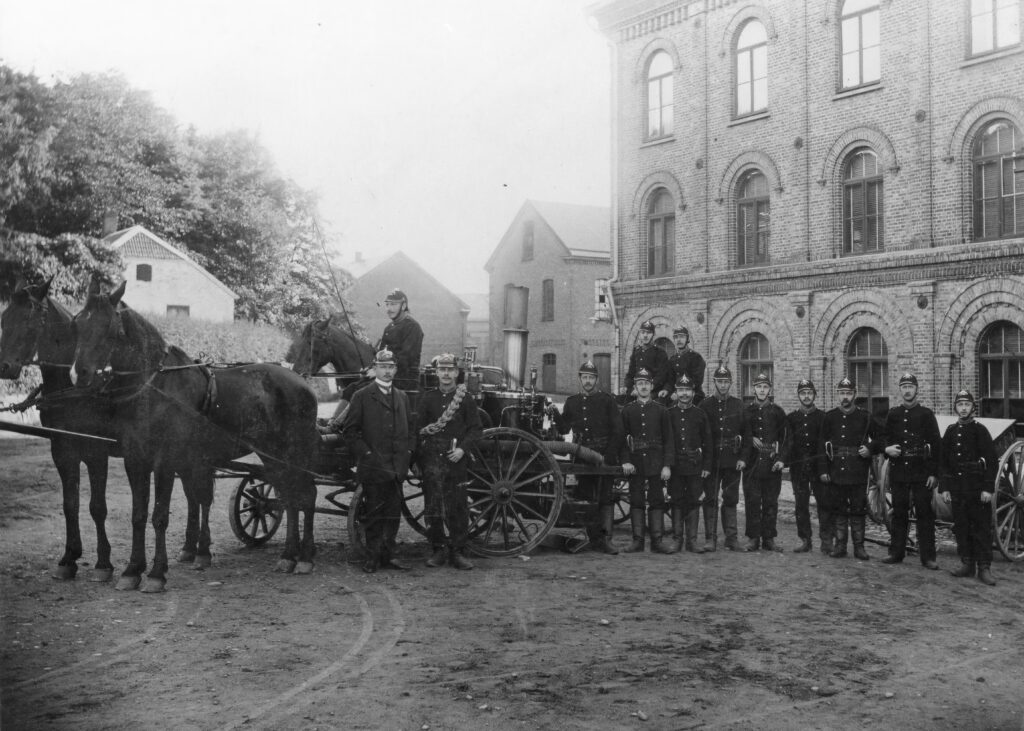
In 1903, Halmstad established a professional fire brigade. The firefighters lived in “barracks” next to a new fire station at Lilla Torg. Fire engines were initially horse-drawn, with horses and wagons used to respond to emergencies. In 1922, the fire brigade acquired four motor vehicles purchased in Germany.

The fire station at Lilla Torg
The continued development of the fire service focused on modernising alarm systems, ladders, pumps and other technical equipment.
From 1965, the county council took over responsibility for the ambulance service. The fire brigade’s duties were also expanded to include smoke diving and water rescue.
In 1977, the fire brigade moved from Lilla Torg to new premises at Kristinehed.
Sources:
GHÅ 1929: Axel Westman. Brandväsendet. Edsvådor.
GHÅ 2003: Hans Helander. Halmstad brandförsvar 100 år.
Halmstads brandförsvar. Återsken – ett sekel i elden

For a long time, Halmstad had very little in the way of trained medical professionals. Pharmacists established themselves in the town as early as 1674, while the first district physician was appointed in 1752. Midwives had been working in the town since the beginning of the 1820s. In 1870, the first private medical practice opened, and around the same time a private dentist also established a practice in the town.

In 1869, a hospital opened in a new building between Södra vägen and Dragvägen.
A county hospital was established in the mid-1770s at Stora Torg. In 1835, the hospital moved to the governor’s residence at the former Crown Distillery on Söder. Halland County Council began its work in 1863, and in 1869 it opened a hospital in a new building between Södra vägen and Dragvägen.
In 1915, Halmstad’s new hospital opened at Galgberget. It has been expanded and rebuilt several times and today serves as Halland Regional Hospital.
A separate infectious diseases hospital opened in 1882, a couple of hundred metres east of the hospital.
Halmstad’s new hospital at Galgberget.
For a long time, the main role of healthcare was to prevent the spread of infectious diseases and relieve the suffering of patients who had contracted them. Minor surgical procedures were also sometimes carried out.
Another important task was maternity care, which could often save the lives of both mothers and babies.
It was really only during the 20th century that healthcare gained access to the medicines and equipment needed to provide more advanced medical treatment.
Sources:
GHÅ 1940: Axel Westman. Helso- och sjukvård i Halmstad.
Svenska stadsmonografier – Halmstad. Henrik Laurell. Hälso- och sjukvård

After the monasteries in Halmstad were closed down in the 1530s, the Danish king instructed the town’s mayor to use one of the vacated monastery buildings as a hospital for poor people.
When Halmstad became Swedish, responsibility for poor relief rested firmly with the town’s inhabitants. At the same time, many poor people were left with little choice but to beg. Begging was regulated through officially approved begging days and lists of beggars who had been “approved” by the town. Over the centuries, the town also had several poorhouses.
The Poorhouse at Lilla Torg
Following new poor relief regulations introduced in 1847 and 1852, special poor relief boards were established in towns and parishes. At the same time, attitudes towards people in need became somewhat more generous.
In 1859, Halmstad opened a new, larger poorhouse at the corner of Bankgatan and Köpmansgatan.
Despite being expanded, the poorhouse was considered outdated and inadequate after just a few decades. As a result, in 1901 a new institution called “Halmstad’s Poor Relief Home” was built in the eastern part of the town. It was later renamed S Olofshemmet.

S Olofshemmet, now part of Sturegymnasiet
Poor relief in Halmstad involved more than just institutions. It also included organising financial assistance, placing children in foster homes and arranging for children to be boarded out with other families. In the 20th century, the town also provided a limited housing service.
In 1918, Sweden introduced a new Poor Relief Act, which remained in force until 1955. The new law brought a more humane and modern approach to poor relief and paved the way towards today’s more developed social support for the elderly, people who are ill and people with disabilities.
Sources:
GHÅ 1930: Axel Westman. Fattigvård under äldre tid.
GHÅ 2014: Kerstin Wedin. ”Vem tar ansvar för de oskyldiga barnens framtid?”

 English
 Svenska