Trade and Shipping in the 17th Century
The source for this article is the Tollage Book of 1671, the only surviving account book from Halmstad...
The source for this article is the Tollage Book of 1671, the only surviving account book from Halmstad...
The first modern harbour quay was built between 1842 and 1847 on the western side of the River...
Trade developed rapidly during the 19th century. The town’s population increased more than tenfold.
In 1898, Janne Richardson took over the Ljungberg Tannery, a long-established and highly traditional business in Halmstad.
The history of beer in Halmstad is as long as the town’s own history, although the earliest evidence...
On the banks of the River Nissan, right next to today’s Österbro, stood the cradle of Halmstad’s industrial...

The source for this article is the town account book for 1671, the only surviving account book from the 17th century. Most of the book consists of the Tollage Book, recording the various duties and fees levied in connection with the import and export of goods.
An article about the account book was published in GHÅ in 2005.
The complete transcription of the account book is available on the Gamla Halmstad website.
By 1671, Halland had been Swedish for 26 years, but commercial ties with Denmark remained. Apart from Denmark, Halmstad’s merchants mainly traded with ports in Germany and the Netherlands.

Extract from the Tollage Book, 1671
Krejer, a type of sailing vessel from the 17th century
In 1671, Halmstad appears to have had only one larger vessel, Röda Rosen, measuring 28 lasts. In addition, there were several smaller vessels of between 3 and 8 lasts.
Five shipmasters from Halmstad have been identified in the Tollage Book.
Anders Olsen was the master of Röda Rosen.

Amsterdam in the 17th century – painting by Jacobus Storck
In June, Röda Rosen arrived in Halmstad from Danzig carrying 571 barrels of rye.
In July, Röda Rosen sailed to Amsterdam carrying tar, potash, and iron.
In August, Röda Rosen arrived in Halmstad from Amsterdam carrying 401 barrels of salt, East Indian spices, and other goods.
Halmstad is estimated to have had around 1,000 inhabitants at the end of the 17th century.
This corresponds to approximately 200 families throughout the town.
These were unsettled times, and at times a large number of soldiers were also quartered in Halmstad.
It had been only 26 years since Halland became Swedish, and many Halmstad residents still retained Danish sympathies.
The goods imported into the town indicate that there was an upper class in Halmstad with enough means for “luxury consumption” in the form of music, fashion, and fine food.

Examples of goods delivered to the merchants Albrekt Börgesen and Henrich Pedersen aboard Röda Rosen in August 1671.
Cardamom
Cinnamon
Ginger
Anise
Nutmeg
Coriander
Preserved ginger
Cloves
Three dozen white bone plates
Whalebone
Rice paper
Sulphur
Spanish green (pigment)
Raisins
Prunes
Almonds
There was whalebone among the cargo carried by Röda Rosen.
Its most common use was as stiffening material in corsets.
The bones were strong and flexible, so they were also used for umbrellas and fans.

Whalebone
Some musical instruments shipped to Halmstad in 1671

Violins

Shawm

Children’s pipes

Jew’s harps
Some dyes shipped to Halmstad in 1671
Russian Yellow – a warm, dark yellow shade that was commonly used as an exterior paint for houses and for interior decoration.
Brazilwood – a dark red dye obtained from the bark of a tree native to Brazil.
Lead White – commonly used in both artistic and architectural painting.
Oak Gall – a dye that can produce shades ranging from grey-brown to plum-purple. Oak galls are growths that form on the leaves of a type of oak found in the Mediterranean region.
Lamp Black – a black pigment made from fine carbon powder. It was used in both artistic and architectural painting.
Fruit and foodstuffs shipped to Halmstad in 1671
Lemons
Bitter oranges
Figs
Currants
Raisins
Prunes
Rice
Walnuts
Almonds
Olives
Olive oil
White sugar
Brown sugar
Soy
Some other goods shipped to Halmstad in 1671
Brass hooks
Brass spoons
Knives
A box of communion wafers
Amber
Shoe buckles
Soft soap
Files
Awl points
Clothes brushes
Sail thread
Girth webbing
Scissors
Combs
Thimbles
Halmstad’s trade declined during the 1670s, creating problems for the town’s authorities, who were heavily dependent on revenue from the Tollage. In 1671, the town’s debt amounted to one and a half times its annual revenue.
At this time, it was not banks or other financial institutions that provided loans. Instead, the town’s debts were owed to the mayors and aldermen, who personally lent money to the town or chose not to draw their salaries.
Looking at the goods imported into Halmstad, it appears that those who could afford it had access to quite a wide range of what might be called the “luxury goods” of the time: exotic spices, dyes, imported fabrics and clothing, and much more.
Sources:
GHÅ 2025: Sven Johansson. Halmstad stads kassabok för 1671
Den kompletta avskriften av kassaboken finns på Gamla Halmstads hemsida.
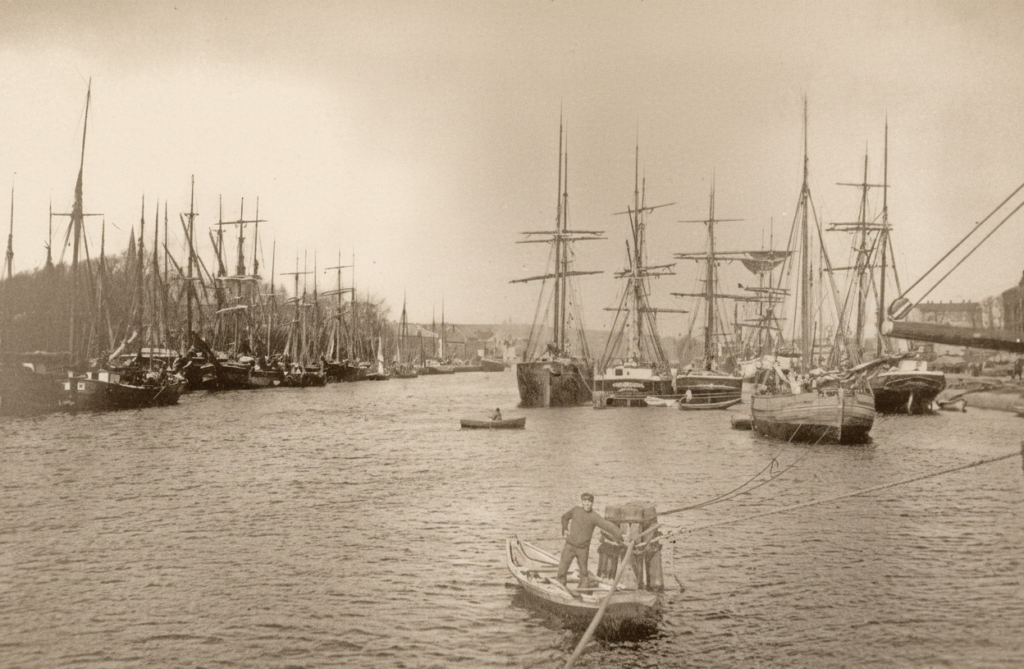
Halmstad grew up near the mouth of the River Nissan. This made it possible to transport goods to and from the town by smaller vessels. However, because the Nissan was relatively shallow, larger ships had to load and unload their cargo at the roadstead off Knebildstorp, outside the river mouth.
With the help of government funding, the harbour was modernised between 1837 and 1840 by extending the piers and dredging the river.
Halmstad harbour with sailing ships.
The first modern harbour quay was built between 1842 and 1847 on the western side of the River Nissan, extending southwards from Österbro.
These investments led to a significant increase in shipping, with sailing ships and steamships travelling mainly to ports in Denmark, Germany and Britain. Halmstad became more closely connected to the outside world, and the town’s economic development began to accelerate.
When Halmstad’s railway station was built on the eastern side of the River Nissan, there was a need to move the harbour to the same side. This made it easier to transfer goods between trains and ships.
The history of Halmstad’s harbour thereafter was one of gradual expansion, with port operations extending ever farther towards the mouth of the River Nissan. Today, almost all harbour activities take place on land reclaimed from the sea in the Kattegat, south of the river mouth.
During the Crimean War of 1853–1856, Britain was cut off from its imports of oats from Russia.
This created new opportunities for exports from countries such as Sweden. In Halland, agriculture had been modernised, and the climate along Sweden’s west coast was particularly well suited to growing oats. This led to large-scale exports of oats to Britain.

Although the trade declined again after a while, business connections had been established. Halmstad continued to export goods such as butter and bacon. Large quantities of timber were also exported to Britain, including so-called pit props, used to support the roofs of mines.
One result of this growing trade was that many merchants in Halmstad invested in sailing ships. Around 1900, Halmstad was considered the third-largest home port in Sweden for sailing vessels.
The Lumberyard Riots in Halmstad harbour in 1931 were a dramatic episode. Times were hard, and the workers demanded higher wages.
Instead, the employers responded by cutting wages. The result was a labour dispute, and the employers brought in strikebreakers. This led to several days of violent clashes between demonstrators and the police.

The accommodation ship “Lumpa-Lena”, where the strikebreakers lived.
On Thursday, 23 April, the situation had become extremely tense. The mayor chose to read the Riot Act to the crowd. This was a final warning before the authorities brought in all available resources, including the military, to restore order. The demonstrators, however, remained aggressive.
Then Edvin Jansson stepped in. He was a respected trade union leader and politician. At a crucial moment, he climbed onto a railway wagon in the harbour and spoke in such a loud voice that the demonstrators fell silent and listened. In this way, he managed to restore calm and restraint.
The following day, the authorities had called in soldiers, while machine guns and sandbags were put in place as the workers gathered in the harbour once again. The police fired warning shots, but the military did not fire a single shot. The conflict was eventually resolved through mediation.
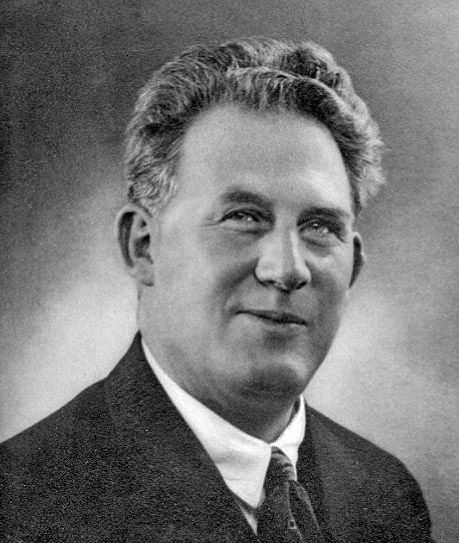
Edvin Jansson
A few weeks later, a similar situation occurred in Ådalen in northern Sweden. Many of the strikebreakers who had been in Halmstad were transported to Ådalen. There, the situation ended with the police opening fire on demonstrators, killing five people.

Halländska Ångfartygs Bolaget was founded in 1850 by County Governor P. A. Lewenhaupt and merchant J. P. Dillberg. In 1852, the company began operating steamships from Gothenburg along the coast, calling at Halmstad and other ports before continuing south to Copenhagen and Malmö. A year later, the route was extended to Lübeck in Germany.
Both freight and passengers were carried. In 1928, the company’s offices were moved to Gothenburg, and its shipping services were discontinued after the Second World War.

Engineer Carl Bissmark was director of Halmstads Stenhuggeriaktiebolag. In 1896, together with the Hamburg-based shipbroking firm C. E. Golterman, he founded the shipping company Bissmark Linie GmbH.
Their idea was to handle and coordinate the export of stone from south-western Sweden to Germany. In the opposite direction, the ships carried general cargo brought to Hamburg by the German shipping lines.
Bissmark Linie ceased operations in 1949.
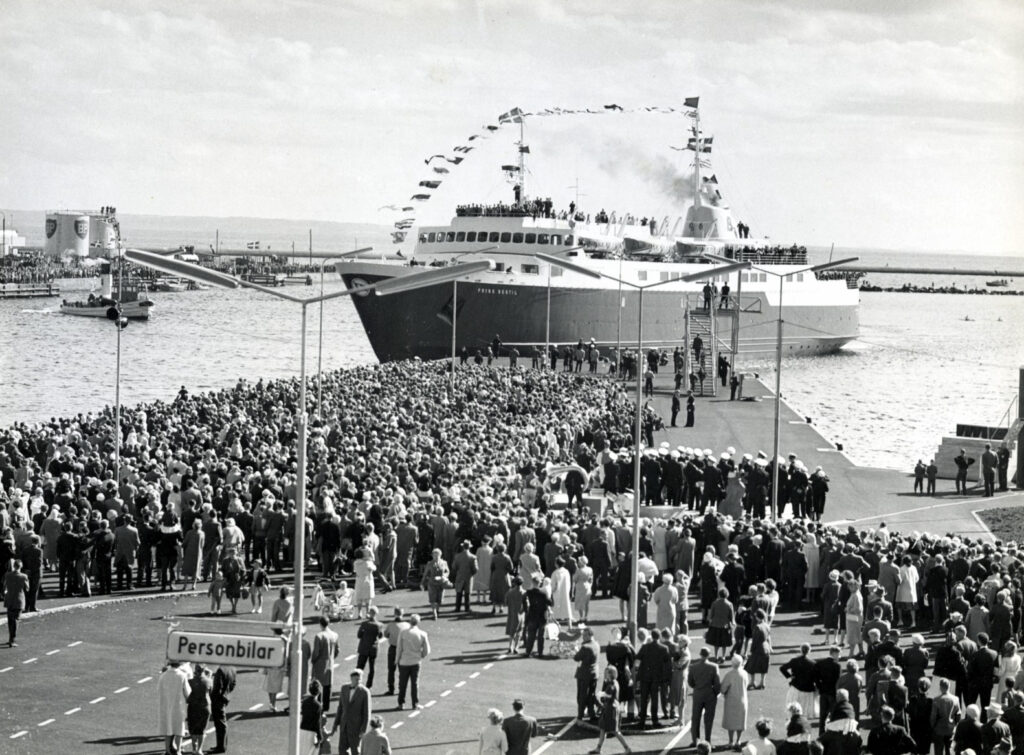
The ferry Prins Bertil arrives in Halmstad in 1960.
The ferry company Lion Ferry opened a ferry service between Halmstad and Aarhus in Denmark in 1960. Later, services were also introduced on routes to Copenhagen, Grenaa and Travemünde.
The ferry service in Halmstad was discontinued in 1966, but Lion Ferry’s head office remained in Halmstad. The company grew into one of Sweden’s leading ferry operators, with services on three Swedish routes and three international routes. The business was closed down in 1982 due to poor profitability.
The name was revived between 1984 and 1988, this time as a company within the Stena Group.
Sources:
Erik Rasmusson. Hallandica – berättelser om ett Kanaans land i Sverige.
GHÅ 1984: Gösta Johansson. Minnesbilder från arbetarrörelsen i Halmstad.
GHÅ 1982: Hans Malmgren. Brädgårdsoroligheterna i Halmstad 1931.
GHÅ 1982: Valfrid Göransson. Den sociala bakgrunden brädgårdskonflikten.
GHÅ 1966: Herman Kronqvist. Bissmark Linie G. M. b. H.
GHÅ 1946: Carl Hammar. Glimtar från ett gammalt ångbåtsbolag.
100 år i sjöfartens tjänst – Hallands Ångbåtsaktiebolag. 1950.
Anders Bergenek. Vårt Lion Ferry.

An important part of obtaining town privileges was the right to engage in trade. For a long time, this mainly involved the exchange of goods between the town’s burghers and farmers from the surrounding countryside.
During the 18th and 19th centuries, regular markets were held in Stora Torg in Halmstad.
Trade developed very rapidly during the 19th century. The town’s population increased more than tenfold. Shops began to appear in the town’s courtyards and in premises facing the street, with display windows where goods could be presented to customers.
Over time, the shops became increasingly specialised. Fairly large wholesale businesses also emerged. Many merchants became wealthy, and a new social class began to take shape.
Market day at Stora Torg in the 1920s.
The abolition of the guild system in 1846, the laws introducing freedom of trade in 1864, and the establishment of modern banks gave a major boost to trade and private businesses.
The steamship Halland, operated by Hallands Ångbåtsbolag.
Industrialisation, together with modern means of transport such as steamships and railways, brought a wider range of goods to the town. Rising prosperity also stimulated trade, and Halmstad’s town centre became a bustling commercial hub.
The way people shop and do business has changed continuously. In 1934, Halmstad got its first indoor market hall, located on Karl XI väg. In 1962, the town’s first department store, Tempo, opened in Nyhem. Several more department stores followed in the town centre.
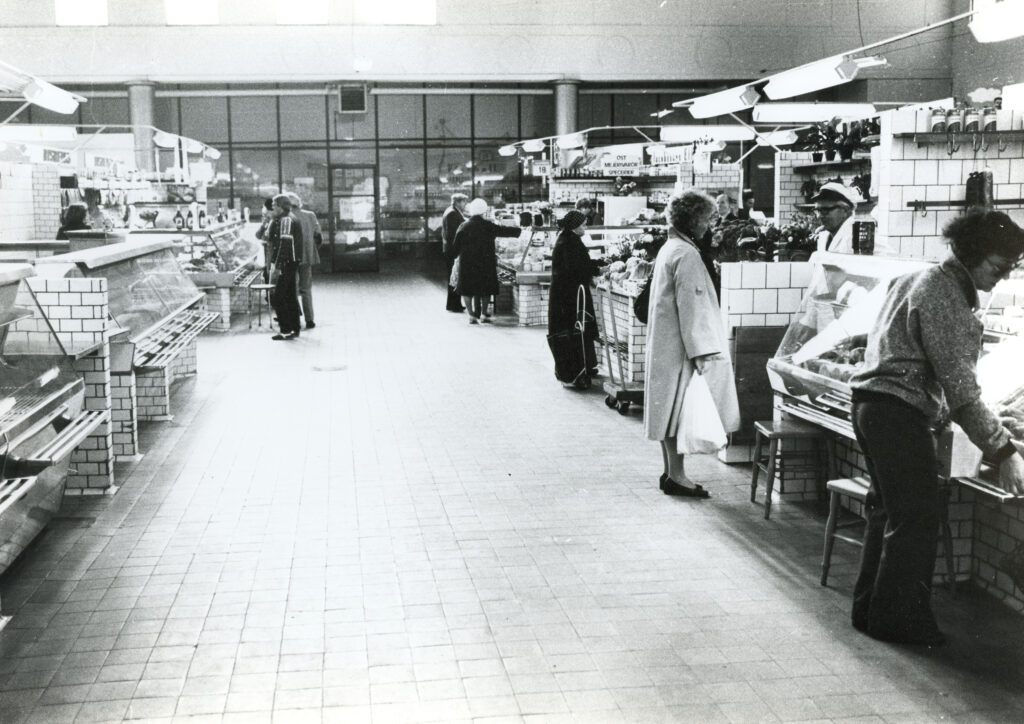
The market hall
In 1991, Halmstad got its first out-of-town shopping centre, Eurostop, at the southern entrance to the town. Today, it is known as Hallarna. Flygstaden began to be developed in 2002.
These developments have led to a decline in the number of shops in the town centre. The growth of online shopping has also contributed to this trend.
Source:
Bengt Gärdfors. Köpstaden vid Nissan
Some Notable Merchants from the Town Model Era

Look at your shoes — others do!
One Sunday in March 1898, Janne Richardson boarded a train in Gothenburg. He was almost exactly 31 years old and had spent many years travelling as a journeyman, venturing as far as Budapest.
He was heading to Halmstad to inspect a business he was interested in acquiring.

Richardson’s tannery.
The business was the Ljungberg Tannery, a long-established company steeped in tradition. It had occupied the same site, now Brogatan 13, since at least the beginning of the century and had had four owners in total.
But tradition did not mean a monopoly. The tannery was struggling badly under competition from other businesses. It was therefore not only steeped in tradition, but also weighed down by debt.
But Richardson saw the potential. He raised money through private loans and took over the business almost immediately. This marked the beginning of its transformation from a struggling company into a large enterprise encompassing a tannery, leather trading, a shoe shop, a shoe factory, a mechanical workshop and a car dealership.
There were plenty of shoemakers in Halmstad — 15 of them when Richardson arrived — but there were few workers, and production was still largely based on traditional craftsmanship.
This was where Richardson saw his opportunity. With the help of machinery, shoe production could be made more efficient. In 1902, he therefore began manufacturing shoes, initially made of felt.
Richardson’s shoe factory.
But Richardson was not alone. Ten years before he arrived, Carl Francke had come to Halmstad. He was also a tanner, and in 1897 he opened a leather business at Brogatan 9. He too went on to run a shoe factory: in 1905, he took over a felt-shoe factory that had been operating in the southern part of town for a few years.
Both factories soon began manufacturing leather shoes. Growth was rapid. The industry reached its peak in the late 1940s, when the two shoe factories together employed around 500 people. This figure does not include the workers at the many smaller factories that had sprung up in the shadow of Richardson’s and Francke’s businesses.
But the crisis was not far away. Competition from southern Europe became increasingly difficult to withstand. Richardson’s factory closed in 1956, although limited slipper production resumed from 1960 to 1971.
Francke’s shoe production ended in 1969. Halmstad’s last shoe factory, Landins, closed in 2006.
Sources:
Henry Bengtsson. Halmstads industrihisoria Del I Allmän bakgrund samt läder-, sko- och handskindustrin
Hallandsposten 1995-09-23:21, 2016-09-24:29

Beer, one of the healthiest and most nourishing drinks
The history of beer in Halmstad is as long as the town’s own history, although the earliest evidence of beer production dates back only to the late 14th century.
The records from the following centuries contain accounts of both beer imported from Germany and beer produced by local brewers. But by the end of the 18th century, no brewers were recorded anymore. They were apparently no longer considered necessary. Somehow, the town’s innkeepers had acquired not only the right to serve beer, but also the right to brew it themselves.
But new times call for new approaches. In 1821, Sven Segerlund moved to Halmstad and established himself as a brewer while also running a farm.
Seven years later, another farmer’s son, Bengt Pålsson Malmros, moved to Halmstad intending to become a grocer. When that plan failed, he became a brewer instead.
Within a few years, Segerlund’s business was forced out of the market, leaving Malmros to run his brewery without serious competition for several years.

The Appeltofft Brewery in the Tre Hjärtan property.
However, in 1836, an event took place that can be seen as the beginning of the industrialisation of brewing in Halmstad. The merchant — or, more accurately, the all-round businessman — Anders Julius Appeltofft bought the property now known as Tre Hjärtan. In the courtyard, he set up a small brewery producing beer and svagdricka, a traditional Swedish low-alcohol beer.
This marked the beginning of a long period during which the two breweries operated side by side. Appeltofft, however, was not content with small-scale, craft production.
In 1861, the brewery was formally incorporated as a limited company, partly to make it possible to finance an investment in the latest development in the world of beer: Bavarian-style bottom-fermented beer, alongside traditional products such as sweet beer and svagdricka.
By the time the brewery was incorporated, Malmros had finally given up brewing, probably in 1858.
The competition had most likely become too difficult, as another brewery, Östra Bryggeriet, had already been established in 1846.
Its range of products was largely identical to Appeltofft’s. And, like Appeltofft’s brewery, it was later converted into a limited company, in Östra Bryggeriet’s case in 1863.
Östra Bryggeriet
With this, the lines of competition in the town were established and would remain in place until 1979. Two large breweries competed for a place in Halmstad. Sometimes one was the larger of the two, sometimes the other. The many other breweries that were established in Halmstad, particularly towards the end of the 19th century, had little impact on this rivalry.
The real battle was between Östra and Appeltofft’s, something that was even reflected in the serving of pilsner at Halmstad’s public restaurants: Östra’s beer was more common on the eastern side of town, while Appeltofft’s was more popular on the western side.
The rivalry was not confined to Halmstad; it was taking place throughout Sweden. During the 20th century, the brewing industry underwent major restructuring, causing most breweries to disappear, be taken over or close down. Östra’s was one of the casualties in 1979, when Appeltofftska Brewery bought its competitor.

Appeltofftska Brewery, today Krönleins.
Appeltofftska Brewery is still operating in the town centre, at the site to which it moved in 1898, although since 1996 it has operated under the name Krönleins.
Today, there is new local competition. During the 2010s and 2020s, several microbreweries have been established: Halmstad Brygghus, Strandlida Bryggeri, Timjans Brygghus, Imperiebryggeriet and Wapnö Gårdsbryggeri.
Sources:
Henry Bengtsson. Ölet i Halmstad (manuskript)
GHÅ 2003: Bengt Blom. Om bryggerier i Halmstad 1838-1899.
Peter Sandberg. Svensk bryggerihistoria. Öltillverkning under 200 år.
Mattias Öbrink (red). Halmstads äldsta historia Vår By Broktorp

“…genuine blue cheviot for suits…”
On the banks of the River Nissan, right next to today’s Österbro, stood the cradle of Halmstad’s industrial development. In 1823, a small and insignificant textile factory was taken over by dyer Isak Reinhold Wallberg.
Production increased rapidly, almost tenfold in just three years. The reason was that Wallberg had focused on producing textiles for the needs of the Swedish army. Despite several new buildings being constructed during the 1830s and 1840s, the expanding business, with around 150 employees, could no longer be accommodated within the town walls.
Slottsmöllan 1856
New land was available to the north of the town, more or less adjacent to the old settlement of Övraby. But it was not the connection with the past that attracted Wallberg. There was plenty of land, largely unused, and, most importantly, there was a waterfall that could be harnessed to generate power.
Wallberg’s new factory complex went into operation in 1850. The textile factory was at the heart of the enterprise and was highly competitive. Some of the first, perhaps even the very first, power looms in Sweden were installed here.
But locating the business outside the town also opened up entirely new opportunities. The mill was incorporated into the company, while the business also began producing bricks and farming.
Further expansion required more capital, so the company was reorganised as a limited company in 1857.

The hat factory by the River Nissan.
In 1887, the company entered a new field. Hats were to be manufactured both in Halmstad and at the new factory in Oskarström. But for once, the venture was not successful, and in 1900 the business was transferred to a newly established company. This, however, did not last long either; it was liquidated in 1905.
The ventures into the production of knitted goods in 1888 and industrial felt in 1894 were more successful.
The company had now built its business around four main products: woollen cloth, knitted goods, industrial felt and bricks. Farming and the mill, meanwhile, became increasingly less important.
Wallberg’s remained a strong company for many years. As late as 1951, it employed more than 800 people. But tougher times were approaching. International competition became increasingly difficult to withstand, and the company was gradually dismantled.
The production of woollen cloth, the company’s signature product, was discontinued in 1968. Knitted-goods production followed the same path that year. The brick and industrial-felt businesses proved more resilient. Both could be sold: the brickworks was sold in 1987 but closed down as early as 1994, while the industrial-felt business was sold in 1988 to the local competitor Nordiska Filt/Albany.
The old industrial complex lives on, albeit in a different form. Today, the area is owned by Slottsmöllans Fastigheter, a direct successor to Wallberg’s, whose purpose is to own, develop and manage Slottsmöllan Business Centre.
Sources:
Bengt Gärdfors. Historien om Wallbergs industrier och Slottsmöllan. Halmstads Industrihistoria V
Hallandsposten 1994-06-10:sid 1, 28
www.slottsmöllan.se

 English
 Svenska


