Lilla Helvetet and Other Beer Taverns
Before 1874, no licence was required to serve beer, and Halmstad had a large number of beer taverns.
Before 1874, no licence was required to serve beer, and Halmstad had a large number of beer taverns.
In the courtyard of Storgatan 40, Wilhelm August Wred opened his salon in 1856.
On the corner of Brogatan and Köpmansgatan, Georg Baertling built a large property in the 1870s.
Both Mr and Mrs Toll were passionate book lovers and continued the traditions that Anette had grown up...
Winters in the 1890s were generally much colder than they are today. The most popular winter pastime was...
Folkparken in Halmstad began its activities in 1927, when the Folkets Park Association acquired Sommarlust in Furet.
When summer arrived, Laxön opened its doors. The dance floor was partly open-air, leaving visitors exposed to the...
On 14 February 1858, a young singer named Kristina Nilsson performed at Wred’s Salon in Halmstad. Kristina Nilsson...
On 1 May 1900, the new entertainment venue was ready to open, and Furet had been given a...
In 1905, the town’s first permanent cinema opened in the so-called Baertling House, on the corner of Köpmangatan...
“The cosmopolitan twins, the world’s youngest and finest performers, Scandio and Oreste Tognarelli.”
In 1858, Fredrik Mårtensson from Ljungby opened an inn and hotel at Storgatan 52, near Norre Port.
Norre kavaljeren, or simply “Kavven” as it was known locally, existed from 1959 to 1999, when the premises...
In 1926, the rules governing the serving of pilsner in Halmstad were changed. This marked the beginning of...
The obvious centrepiece of Tylösand today is Hotel Tylösand, owned by music star Per Gessle and entrepreneur Björn...
During the 1930s, as tourism and holidays began to become accessible to people from all walks of life,...
The building that once housed Källaren Laxen was designed by city architect Knut Beckeman and built in 1885.
During the 1960s, and especially in the 1970s, dance halls began to change. The disc jockey emerged and...

In the 17th century, many soldiers were billeted with the burghers of Halmstad, and many of these townspeople also ran taverns. Beer flowed freely, and fights were common, as can be seen in the court records from the period.
The oldest tavern in Halmstad whose name we know was Lilla Helvetet (“Little Hell”), located on Kyrkogatan at the bottom of the street, near the River Nissan. The building that housed the tavern was demolished in 1908, and it is believed that a tavern had operated there since the 1620s.
Towards the end of the 19th century, the tavern was run by Moster Ulla (“Aunt Ulla”). She ran the establishment with a firm hand, and her customers had great respect for her. Her name was Ulla Hjelmström, and the business was highly profitable, judging from the tax records.
Lilla Helvetet also became Halmstad’s first drive-in bar. A coastguard officer rode past the tavern every day and was served a glass of Madeira through the window – without even dismounting from his horse.

Pencil drawing of the intersection of Hamngatan and Kyrkogatan. Lilla Helvetet can be seen on the left. Photo from Bildstationen.
Before 1874, no licence was required to serve beer, and the number of beer taverns in Halmstad was large. The 1958 city yearbook lists 30 taverns that operated in the late 19th century, giving their names and a brief description of each.
Most of the beer taverns consisted of a bar counter with a corkscrew-style bottle opener. Customers sat at long tables made of rough, unpainted planks, with long benches on either side.
In Halmstad, new regulations were introduced in 1922 requiring customers to order food when buying beer or spirits. There was also a limit of 15 cl of spirits per person. After this, the number of beer taverns declined rapidly.
In 1926, the city council decided to establish Halmstads Folkrestauranger AB, which was given exclusive rights to operate simple restaurants. Food now became the main attraction, while beer became secondary.
All the establishments mentioned below, where beer and spirits were served, were very simply furnished. Many had long tables made of rough, unpainted planks, particularly the beer taverns. The stools and benches were just as basic as the tables. This was probably necessary, as the furniture often had to withstand a fair amount of wear and tear.
Beer was usually served from a counter equipped with the obligatory cork-opening device. Thick drinking glasses stood on a shelf behind the counter.

At the intersection of Kyrkogatan and Hamngatan stood the Lilla Helvetet tavern. Photo from Bilstationen.
When the right to serve beer and spirits without serving a cooked meal was abolished, Halmstad’s breweries were initially allowed to set up their own drinking establishments.
These brewery-run premises eventually disappeared as well. They were replaced by Halmstads Folkrestauranger AB, which was given exclusive rights to operate beer taverns. By then, however, these establishments had more or less been transformed into pleasant, simple restaurants where food was the main attraction and beer played a secondary role.
An anonymous member of Gamla Halmstad, who had grown up outside the town and frequently travelled to Halmstad during the 1890s and the years around the turn of the century, compiled the following list of the simpler drinking establishments of the time on behalf of the association.

In 1856, Consul Wilhelm August Wred bought the property at Storgatan 40. The seller was master innkeeper Anders Sjögren, who now moved all his activities to Norre Katt and Tivoli, which he already owned.
Behind the building facing Storgatan stood two timber-framed wings. One ran along Bankgatan towards Hamngatan, while the other ran parallel to it further inside the courtyard. Both wings had originally been built as warehouse buildings, probably towards the end of the 18th century.
It was in the wing at the back of the courtyard that Wilhelm August Wred opened his salon. His aim was to offer all kinds of stage entertainment and to organise social gatherings and balls.
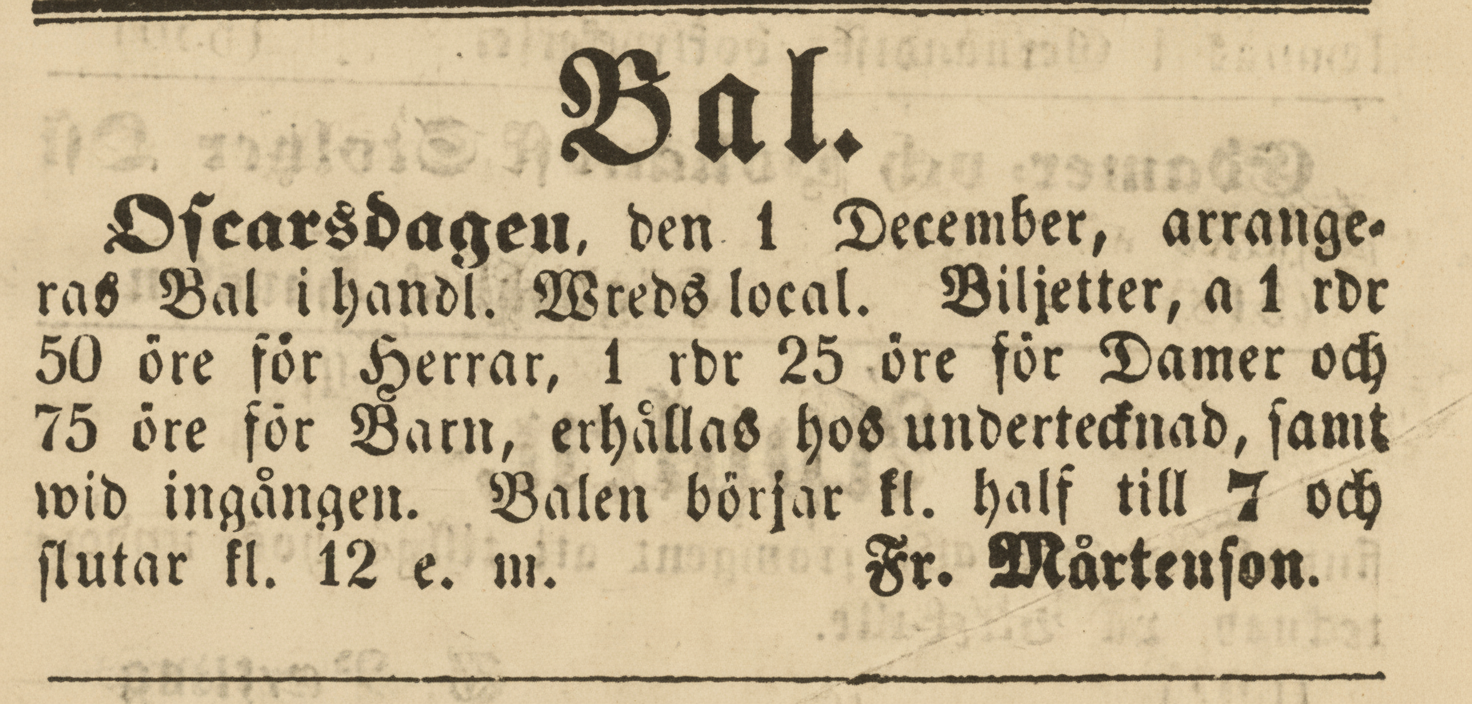
Advertisement in Hallandsposten, 25 November 1858.

Wred’s Salon was located in the courtyard of Storgatan 40.
The picture shows the courtyard behind Skånska Hembageriet, seen from Hamngatan. The wing on the right is still occupied by the bakery, although it is somewhat shorter than it originally was. The same is true of the parallel wing. When Wred’s Salon was located there, the building extended considerably farther towards Hamngatan.
It was here that the famous Swedish soprano Kristina Nilsson made her public debut in 1858. Wred and his estate retained ownership of the property for almost 50 years. On 21 August 1905, the property was transferred to his long-time assistant, Sven Johan Ingemansson.
For a considerable period in the early 20th century, the upper floor housed a silent-film cinema called Stora Biografteatern. It was later home to the Gyllene Salen dance hall, a café, a billiard room and a boarding house. The premises were also home to the municipal City Gallery (Stadsgalleriet) until well into the 2000s.
It is still possible to experience the interior of the timber-framed wing along Bankgatan. Today, Skånska Hembageriet runs its café and bakery business here.
Sources:
FGH 1925: Anonym författare. Några hågkomster och minnen från 1850- och 1860talens Halmstad.
FGH 1926: Knut Beckeman. Några Halmstadminnen från mitten av 1850-talet och ett tiotal år framåt.
FGH 1927: Axel Westman. Något om nöjeslifvet i Halmstad under 1800-talet .
FGH 1934: G. B. Till några av våra bilder.
FGH 1941: Anonym författare. Något om Halmstad för 75 år sedan.
FGH 1969: Sven Tengnäs. Familj Föreningen.
FGH 1983: Eric Hägge. Stadens flagga och flaggorna i staden.
FGH 1952: Ragnar Lyttkens. Några glimtar från det kommunala livet i Halmstad för 100 år sedan.
Gamla halmstads hemsida: Gator i Halmstad, Storgatan – den förnämsta

On the corner of Brogatan and Köpmansgatan, where the Åhléns department store stands today (2025), a large property was built in the 1870s. The developer was Georg Fredrik Teodor Baertling (1832–1879), who had emigrated from Germany in the 1850s.
When he arrived in Halmstad, he worked as a barber and surgeon, but he soon changed career and went on to become a successful restaurateur. He was married to Hilda Albrecht, who came from the French Le Veau family. According to family tradition, the family came to Sweden when Jean Baptiste Bernadotte ascended the Swedish throne as King Charles XIV Johan.

The Baertling Courtyard on the corner of Brogatan and Köpmansgatan.

Georg Baertling
Georg Baertling Sr. was an enterprising businessman, and the impressive property he built and owned by Stora Torg housed a remarkably varied range of businesses and institutions. These included Halmstad Girls’ School and Hotel Central, sometimes known as the Continental, which contained three restaurants: Bodegan, Biljarden and the so-called Gökakrogen.
Biljarden closed in 1911, while Halmstad’s Biograph Theatre moved into the Gökakrogen as early as 1905. A large part of the property was demolished in 1932 to make way for the new EPA department store, which was built on the same site.
Georg Baertling Sr. had five children. Two of his sons remained in Halmstad to help run the family business. One of them, August Baertling, became the father of the internationally renowned artist Olle Baertling. Several of his paintings can be seen at the Halland Museum of Art in Halmstad.
Sources:
GHÅ 1965: Gustaf Wienecke. Huset i centrum
GHÅ 1970: Erik Hägge. Slutet på Halmstads ”Törnrosasömn”
GHÅ 1970: Sten Laufke. Ett immigrantöde från slutet av 1800-talet.
GHÅ 1970: Ludvig Kollberg. 1800-talets Halmstad i modell.
GHÅ 2006: K B Bjering. Gatuhörn som försvunnit.
GHÅ 2008: Anders Bergenek. Sveriges äldsta cykelaffär.
Teddy Brunius: Olle Baertling, Mannen-Verket, Sveriges Allmänna Konstförening 1972

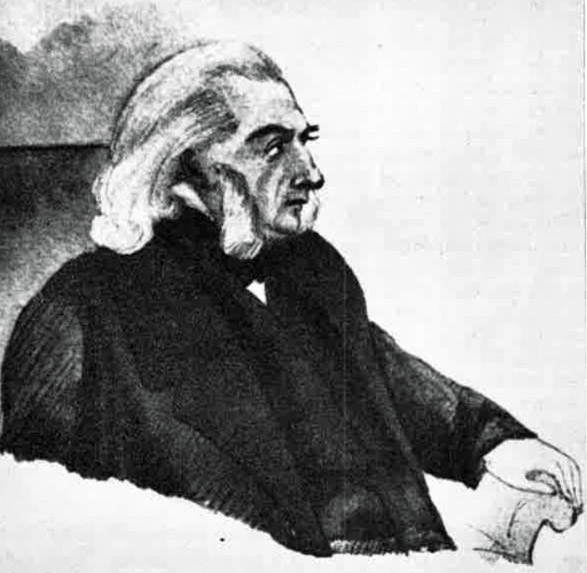
Drawing of Florius Toll
In 1820, Lieutenant Colonel Florus Toll married Anna Christina Johanna Westberg. As part of the marriage, he bought the property at Storgatan 6, where his new wife had grown up.
Both Mr and Mrs Toll were passionate book lovers and continued the traditions that Anette had grown up with. The collection of books they had inherited from Anette’s parents was constantly expanded with new works on a wide range of subjects. The books were also lent to friends and acquaintances in the town.
In 1855, the Tolls donated their collection of books to Halmstad’s Lower Grammar School (Halmstads Lägre Lärdomsskola). The school thereby gained access to around 1,600 books. The detailed deed of donation also stipulated that the books should be available for borrowing.
In this way, the foundation was laid for what would eventually become Halmstad’s public library.
It was not until 1922, however, that the town finally got its first “proper” public library. The following year, the Toll collection was moved into the library, and when the next city library opened on Fredsgatan in 1954, the collection was given a room of its own on the second floor.
Since 2006, the public has been able to view the Toll Collection at the modern Halmstad City Library at Axel Olsons Gata 1.

Halmstad City Library
Sources:
GHÅ 1924: J. H. Pettersson. En donator från förra århundradet.
GHÅ 1980: Ingegärd Larsen. Om Tollska Boksamlingen och Människorna bakom den.

Winters in the 1890s were generally much colder and snowier than we are used to today. Yet skiing, ice hockey and bandy were more or less unknown at the time. The most popular winter pastime was tobogganing in Slottsparken and on the old fortification embankments, where Karl XI’s väg runs today.
Private initiatives also ensured that there were cleared skating areas on the River Nissan, between the bridges, whenever the ice was strong enough. People would stroll along the ice or simply skate leisurely, enjoying the winter weather to the full.

Drawing by Gustav Åhlund

Drawing by Gustav Åhlund
One person who attracted a great deal of attention was a figure skater named Persson, who was widely known as the “Skating King”.
“Dressed in a jacket, striped trousers, a stiff white collar, a pince-nez perched on his nose and a cigar in his mouth, he performed pirouettes on both the outside and inside edges, forwards and backwards, as well as threes and other feats of the highest order.”
Sources:
GHÅ 1949: Gustav Åhlund. Dagligt liv i Halmstad på 1890-talet och ett stycke in på nya seklet.

Folkparken in Halmstad began its activities in 1927, when the Folkets Park Association acquired Sommarlust in Furet.
On 1 April 1931, Bror Walentin Karlsson from Harplinge was appointed manager of Folkparken, marking the beginning of a golden era that would last for almost 30 years.

Photographer Otto Nilsson. Photo from Bilstationen.
At the initiative of Bror Karlsson and others, a huge three-storey entertainment hall was built. It featured a large dance floor, a spacious theatre and concert stage for both indoor and outdoor performances, as well as ample seating areas with café and restaurant facilities.
On Walpurgis Night in 1936, the new dance palace was officially opened. At the time, it was described as one of the largest in Scandinavia and as something entirely new in Sweden’s folk parks.

Photo from Bilstationen,
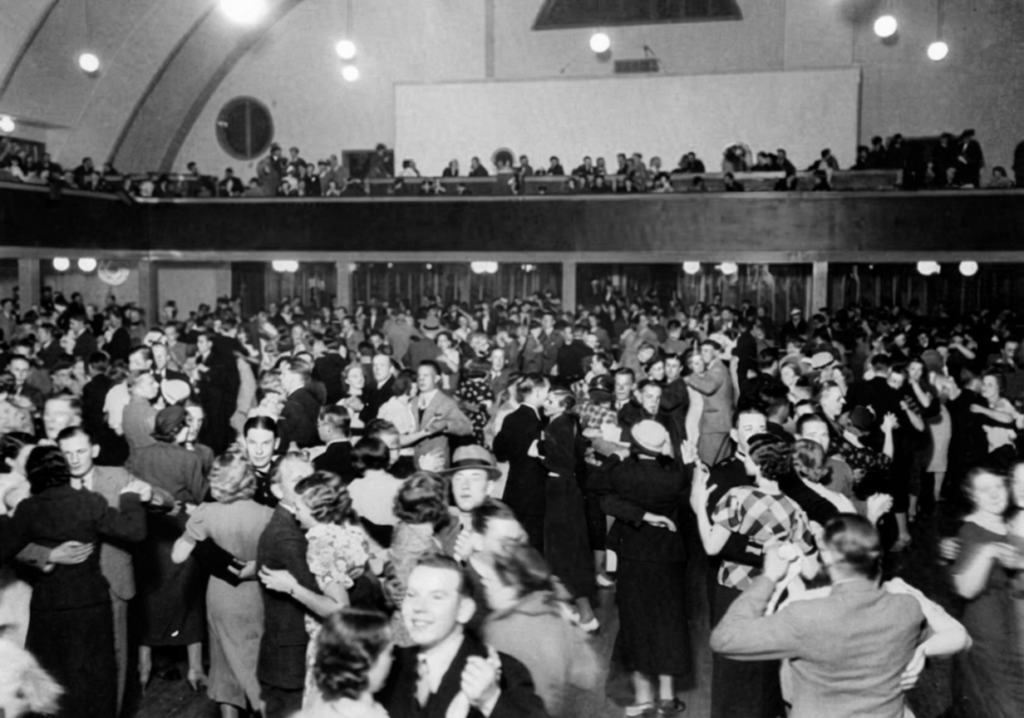
Photo from Bilstationen.
A typical evening at Folkparken would begin with a concert or theatre performance. Afterwards, the rows of audience seating were cleared away and the dancing began, accompanied by the big-band music that characterised the era.
After Bror Karlsson retired in 1960, Folkparken took on a more distinctly youthful character. It hosted a number of Swedish and British bands riding the wave of 1960s pop music. In 1969, a new entertainment venue, Galejan, was built.
In 1979, Galejan was expanded into a larger dance, restaurant and conference complex. At the same time, the large entertainment palace built in 1936 was remodelled and, for many years, became a home for Halmstad’s independent theatre groups.


The Laxen Inn was the first stop in the Saturday-night festivities. Once they had had a drink or two, the urge to take to the dance floor with a girl soon followed. The choice was either Laxön, on an island in the River Nissan, or Sommarlust/Folkparken.
Laxön was considered somewhat more refined and attracted people from the white-collar professions, while “the Park” drew a broader section of the population.
For 15 öre, visitors could reach both venues on Axel Ahlberg’s motorboats, which carried passengers from Tivolibryggan, south of Norre Katts park.
Laxön could also be reached by square, flat-bottomed ferries that were hauled by hand along a wire stretched between the two banks. Folkparken had its own motorised boat, which slowly made its way across the River Nissan from Örjans Vall.


When summer arrived, Laxön opened its doors. The dance floor was partly open-air, leaving visitors exposed to the weather and the elements. The venue had its own special orchestra, led by Helmer Kristiansson, which played modern dance music such as foxtrot, tango and slow waltzes.
The audience was also entertained by performers, while on a bowling alley young men took turns rolling wooden balls between dances on the excellent dance floor.

On 14 February 1858, a young singer named Kristina Nilsson performed at Wred’s Salon in Halmstad. The property was at Storgatan 40, and the salon was located in the courtyard building behind what is now Skånska Hembageriet. Here, audiences could enjoy concerts and a variety of theatrical performances.
Kristina Nilsson was only 14 years old at the time. The concert was organised by her teacher, the singing instructor Adelaïde Valerius, later married to Leuhusen, to help finance Kristina’s further studies.
The concert was a great success – and so was Kristina Nilsson’s career. After several years of study in Paris, she made her debut at the Théâtre Lyrique in 1864 as Violetta in Verdi’s La Traviata. From there, she went on to conquer audiences around the world.

In addition to performing on all the great opera stages of her time and singing before kings, princes and queens – including Queen Victoria of Britain, Emperor Franz Joseph in Vienna and Napoleon III in Paris – Kristina Nilsson was chosen to inaugurate the Metropolitan Opera House in New York on 22 October 1883. At the opening, she sang one of her signature roles, Marguerite, in Charles Gounod’s opera Faust.
Kristina Nilsson retired from the stage at the age of 45, following a concert at London’s Royal Albert Hall. Her very last performance took place in 1893 at a charity concert. From 1897 onwards, she once again spent periods living in Småland, where she had been born and raised.
She died at the Stadshotellet in Växjö in 1921.
Sources:
GHÅ 1955: Oscar Lundgren. Anno 1858 Axplock ur en tidningsårgång.
GHÅ 1987: Joel Almryd. Några minnen från Sperlingsholms kvarn.
Wikipedia: Kristina Nilsson


The first records of Furet as a place of entertainment date back to the 1860s. At the time, young people from the town would head out with a fiddler to the wooded slopes on the eastern side of the River Nissan, where they danced on summer evenings. In 1865, the first dance floor and a carousel were built in Frennarp.
In June that same year, the people of Halmstad also had their first opportunity to enjoy themselves on Laxön, an island in the River Nissan. Enterprising locals organised ferry trips there from the western bank. Visitors danced among the lush greenery of the island, rode the carousel and swing boats, and enjoyed refreshments. Halmstad now had two entertainment venues that would compete for the public’s favour for many years to come.
In the 1890s, Laxön was leased by the Appeltofftska Brewery, while the Östra Brewery did the same with Furet. This gave each brewery a monopoly on beer sales at its respective venue.
By the end of the 19th century, Furet’s dance floor and buildings had fallen into disrepair. The place had become a haunt for troublemakers and those intent on causing disturbances, and fights were commonplace. If people were not fighting over girls, rivalries between different parts of town could spark a brawl – for example, between people from the northern and western districts.
The so-called ligapojkar (“gang boys”) harassed peaceful visitors, who could never be sure of making it home unscathed. The security guards were powerless to stop them, while the Halmstad police had no jurisdiction as far as Furet, which lay in the municipality of Snöstorp.

Photo from Bildstationen.
The Östra Brewery put its brewmaster, Max Fredrik Haberman, in charge of Furet, and he set about renovating the facilities. In 1893, the brewery leased the entertainment venue to a man named Birger Olsson, a former coachman at Slottsmöllan who later spent many years organising entertainment at Laxön.
The legendary restaurateur Georg Baertling was the next tenant of Furet. He had a refreshment pavilion built there, which soon became a popular destination for Halmstad families on an outing.
After Baertling, Furet was taken over by Adolf Gottfrid Meyer, a German musician who had moved to Halmstad from Malmö.
Christian August Freckman, born in Denmark in 1848, moved to Halmstad with his family in 1897. In Copenhagen, Freckman and his family had run a boarding house, and he was now attracted by the opportunity to restore and develop the entertainment venue at Furet.
In 1900, he took over the lease and embarked on an extensive renovation of the buildings and grounds. Everything was painted and spruced up, the vegetation was cleared, paths were laid out, the bowling alley was given new balls and boards, and a grand new dance floor was built.
Down by the River Nissan, a landing place was arranged for a rowing boat that carried visitors across from the western bank for two öre.

Photo from Bildstationen.
On 1 May 1900, the entertainment venue was ready to open, and Furet had been given a new name: Sommarlust, taken from Freckman’s old homeland.
As the audience arrived, the Gjuterisextetten tentatively warmed up their instruments for the evening’s dance music. Serving girls stood ready to bring out food, coffee and soft drinks, while large, sturdy security guards were on hand to prevent any trouble. Beer was still available, but it was served in moderation.
From the very beginning, Christian August Freckman placed great emphasis on good order at Sommarlust, a pleasant family atmosphere and quality entertainment. Sunday mornings began with light background music and breakfast at 35 öre per portion. Throughout the day, visitors could enjoy soft drinks, coffee and food, while the evening brought dancing.
The workers’ choral society performed a programme that included August Söderman’s Wedding March, Ole Bull’s Sæterjentens søndag and the Björneborgarnas March. Alfred Hedin, a mechanic at the town’s electricity works, entertained the audience with songs and storytelling. Fireworks and Bengal lights added to the festive atmosphere.
Crowds flocked to Sommarlust, and Freckman had to advertise for more respectable serving girls and keep the venue open all day. The sale of beer was eventually abandoned altogether, replaced by “Hallands Brewery’s healthy soft drinks from the ice cellar”.
As a major new attraction, vanilla ice cream was sold in wafer cones – a taste sensation for most visitors.
In the winter of 1903, a large covered dance hall was built, featuring what was described as the finest teak dance floor in northern Europe. Generations of Halmstad residents have since danced across its floor, enjoying the silky-smooth surface beneath their shoes.
The dance hall was used for more than 30 years, until 1936, when the present building, Folkparkenhuset, was constructed. A theatre stage was installed inside the dance hall for variety shows and revues.
To keep troublemakers out, the entire area was fenced off, which also made it easier to collect an admission fee.

The boat Duvan carries passengers between the town and Sommarlust. Photo from 1902.
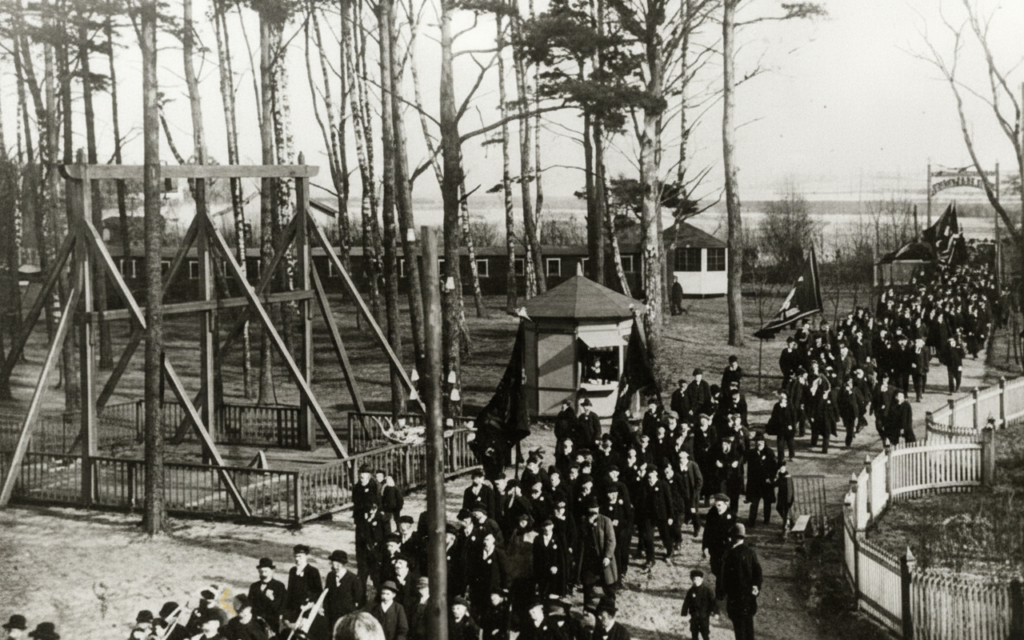
The labour movement marches at Sommarlust, 1908
A few years after Sommarlust opened, C. A. Freckman began working closely with the labour movement. In 1899, the Folkets Hus Building Association had been formed, led by transport worker August Forsberg and blacksmith S. F. Berggren. On 21 December 1902, the association opened its own Folkets Hus.
Sommarlust now became the workers’ summer venue, with half of the income during the summer season going to the Folkets Hus Association. The Folkets Hus board took responsibility for maintaining order and appointed members of the labour movement as guards, several of whom were given police powers.
It was also expected that every respectable worker would do their part to ensure that nothing brought the organisation into disrepute.
On 1 May 1903, Sommarlust held a grand opening celebration, featuring a speech by editor P. Axelsson from Landskrona and performances by the Hantverksföreningen male choir. Large crowds made their way along Furuvägen, while the rowing boat across the River Nissan shuttled back and forth.
Admission was 15 öre, while children were admitted free of charge. Those who simply wanted to dance could whirl around the open-air dance floor at no extra cost, while anyone wishing to try out the new covered dance hall had to pay an additional 5 öre per dance.
Just how popular the new hall had become was demonstrated on Midsummer Eve, when no fewer than 3,000 dance tickets were sold.
Since 1897, the Labour Municipality’s May Day procession had ended at various locations. In 1904, however, the procession marched to Sommarlust, which from then on became the regular meeting place on 1 May. That day, dock foreman John Svensson from Halmstad spoke about the eight-hour working day and universal suffrage
Every year, C. A. Freckman introduced something new to surprise and delight his visitors. A summer theatre opened for pantomimes and other entertainment, fountains were installed, and the water played while the band performed an afternoon concert.
There were also croquet lawns, bowling alleys, swings and a shooting gallery for visitors to enjoy.

Fiddlers’ competition at Sommarlust, 1912
Freckman brought in entertainers who were well known throughout Sweden to perform monologues, sing comic songs, tell local tales and recite poetry. He also invited Halmstad’s Gymnastics and Athletics Club Svea to put on displays of wrestling, feats of strength and gymnastics. On another occasion, he brought the socialist agitator and public speaker Kata Dalström to Halmstad to give a political lecture.
In the years that followed, the programme expanded to include folk dancers, shooting festivals and all kinds of other events, featuring many well-known performers.

The new restaurant, built in 1908.
One of Freckman’s more ambitious building projects came in 1908, when a new restaurant was constructed. Designed by architect Einar Larsson, it was an elegant building surrounded by verandas.
The upper floor housed a photographic studio for Valborg Freckman, who had trained as a photographer and was responsible for many of the photographs that have been preserved from Sommarlust.
The main floor contained several dining rooms for both public and private functions, as well as a smoking room and a café. The opening of the restaurant was a major event. The Snöstorp municipal board was invited, along with representatives of the police, the press and others.
Guests were treated to an excellent supper, accompanied by music from a sextet. Many speeches were made in honour of Freckman and Sommarlust, and the evening continued with pleasant socialising.
By this time, the sporting movement was beginning to grow in Halmstad. There was no proper sports ground, so both football and athletics had to make do with primitive facilities.
Freckman now came to the rescue. A great supporter of sport, he believed it played an important role in the education and development of young people. He therefore offered to build a sports ground at Sommarlust entirely at his own expense.

Pole vaulting at the Sommarlust sports ground
Freckman lived at Sommarlust with his wife and their five children, three girls and two boys. Their home burned down in 1906, but was replaced in 1908 by a villa that still stands on the site today. Alongside running the entertainment venue, Freckman continued to work for Fotogenaktiebolaget until 1914.
On 1 May that year, Freckman put his final plan into action: to turn Sommarlust into a Folkets Park – a public park for the people. He decided that the grounds should be freely accessible to visitors every day. People could come and go as they pleased, and families could bring a picnic basket and spend the whole day outdoors.
Admission was charged only for the dance hall and on occasions when an organisation had hired Sommarlust or a sporting event was taking place.
Freckman had only a few years in retirement to devote himself entirely to his life’s work. He died on 21 October 1917.
In 1927, the Halmstad Föreningen Folkets Park u.p.a. purchased the Sommarlust entertainment venue at Furet from the heirs of Freckman.

In Halmstad, films remained silent until 29 January 1930, when Röda Kvarn presented the town’s first sound film. That did not mean, however, that the cinema had been silent. In the early days, the noise and excitement of the audience filled the hall, mixed with gasps of delight and cries of fright, depending on what was being shown on the screen.
The first moving picture ever shown in Halmstad was screened in the ceremonial hall of the Grammar School in February 1898, about a year after film had arrived in Sweden. In the years that followed, travelling film companies catered to the people of Halmstad’s growing appetite for moving pictures.
Development soon moved on. In 1901, the first film accompanied by recorded sound was shown, using a “graphophone”. Later that same year, live music accompanied a film in Halmstad for the first time. The music was performed by musical director James Gerlach.
In 1905, the town’s first permanent cinema opened in the so-called Baertling House, on the corner of Köpmangatan and Brogatan. This modest basement venue was given the rather grand name Halmstads Biograph-Teater.

The Baertling House, with the entrance to Halmstads Biograph-Teater.

Advertisement for the Biorama Theatre, which opened on Köpmansgatan in 1907.
In the years that followed, competition became increasingly fierce. The travelling film companies continued to visit Halmstad, while several permanent cinemas also opened.
The first national cinema company, AB Svenska Biografteater, later known as Svenska Bio, established itself in Halmstad in 1907, when it had the Biorama Theatre built.
All kinds of films were shown, but not all of them were well received. Among those who were irritated, worried and openly critical was Halmstad’s school administration. The authorities believed that the “cinema menace” endangered schoolchildren’s health, that their money was being wasted, and that begging would inevitably follow.
Moral panic or not, opening a cinema was still seen as an attractive business opportunity. In the years that followed, several new cinemas opened – and, it should be added, several also closed down.

Advertisement for Fotorama Cinema.
But the concerns did not go away, either nationally or locally. The Swedish National Board of Film Censorship (Statens Biografbyrå) was established, and film censorship was introduced in 1911.
In Halmstad, the Child Welfare Board (Barnavårdsnämnden) also took action, this time publishing a pamphlet warning against harmful cinema visits. A review of the board’s case files from the period, however, reveals no connection between the reasons for the investigations and visits to the cinema.
In the years that followed, much the same pattern continued: cinemas opened and cinemas closed. Somehow, there seemed to be a self-regulating factor – perhaps demand! – that kept the number of permanent cinemas to three or four.
Halmstad’s cinema history certainly did not end in 1918. But an era did come to an end that year. Cinema owner August Sellergren, who had been active in the town since 1907, decided to call it a day. Tired of his conflicts with the town’s authorities, he chose to move his business elsewhere.
I
After Gerlach, a long succession of musicians took on the job of accompanying films at Halmstad’s cinemas. Perhaps the most intriguing story is that of “the musical prodigies, the cosmopolitan twins, the world’s youngest and finest performers, Scandio and Oreste Tognarelli (Violin and Mandolin Virtuosos).” That was how they were advertised when they gave a concert at Folkets Hus in April 1904.
Eight years later, they returned, now performing under the name “Brothers Tognarelly”, to play at the Tivoli Restaurant during the Halmstad Exhibition. When their contract came to an end, the brothers moved on to Stora Biografteatern, or Storan, to provide live music for the films.

Scandio and Oreste Tognarelli giving a concert in 1904.
From being a musical sensation, the brothers gradually became part of everyday life in Halmstad. They were a colourful pair. Born in the United States, they were experienced touring musicians who had performed in cities such as New York, London and Paris.
Music was not their only passion: fast cars and aviation fascinated them too. In 1912, they hauled a half-built aeroplane from Copenhagen to Halmstad, intending to make its maiden flight at Östra Stranden. But they lacked both an engine and the necessary funds, so the aircraft never got off the ground – at least not in Halmstad.
The brothers’ time in Halmstad came to an end with a minor drama in 1914. It began with a concert featuring Musical Director Grundström and two amateur musicians. Scandio gave the concert a scathing review in a letter to the editor, and the following day he received a strong response. The writer using the signature “O.H.” accused him of being a dilettante and ended the letter with these words:
“Make less fuss, both in the press and on your violin.”
The following day, cinema owner Sellergren came to Scandio’s defence, and Scandio himself replied. After that, the brothers disappeared from Halmstad.

Letter to the editor in Hallandsposten, 8 January 1914
The brothers probably moved to Copenhagen, where Scandio became a successful orchestra leader, working somewhere between popular music and jazz. He died in Copenhagen in 1961.
What Oreste went on to do is unknown. The only trace we have is that in 1933 he won a Nordic competition for the best waltz melody!


Painting of Fredrik Mårtenson, photographed by Sven Johansson.
Fredrik Mårtenson came from Ljungby and, in 1858, opened an inn and hotel just inside Norre Port, on Storgatan. He had grand plans for Storgatan 52 and immediately began a major refurbishment.
A bowling alley opened in a building along Norre Katts Gränd. In 1863, an assembly hall was inaugurated on the corner of Storgatan and Norre Katts Gränd. It was used for both concerts and theatre performances and, for many years, was Halmstad’s only venue for music and theatre.
In 1920, the Palladium cinema opened in the theatre hall. In the first few years, the entrance was on the park side, with visitors entering via a covered passage over Norre Katts Gränd. But silent films had been shown in the theatre hall long before this. In 1901, a major event took place when the film En juldröm (A Christmas Dream) was shown and, for the first time in Halmstad, the audience was entertained by a cinema pianist.
From the beginning, Mårtenson also ran two summer restaurants in the park, one large and one small. They were popular, and during the first few years the staff had their hands full, as all the food had to be brought over from the hotel. Eventually, the hotel kept only the larger restaurant, known as Upper Tivoli, which stood on a small hill where the bastion is today. By then, it had its own kitchen, had been refurbished with decorative woodwork, and had become one of Halmstad’s most popular venues.

In the middle of the 20th century, Mårtenson was run by Franz and Greta Gruber. She started out as a cleaner, while he was the hotel manager. When they fell in love, he divorced his wife and married Greta, who suddenly found herself in a very different position. Some of her former colleagues found it difficult to accept that she had now moved into the manager’s apartment. But that was where she stayed.

Målning av Greta Gruber avfotograferad av Sven Johansson.
From 1935, the top floor of Hotel Mårtenson was the home of hotel manager Franz Gruber and his wife Greta. When Franz Gruber died, Greta was allowed to remain in the penthouse for the rest of her life, with meals served to her every day.
Greta Gruber was still alive in the 1990s, when Johan Rosenlind worked at Mårtenson. When Johan later wrote the story on which the television series Vår tid är nu (The Restaurant) was based, Greta Gruber became the inspiration for the character known as “The Lady on the Roof”.
Mårtenson also has a bar called Gretas Tak (“Greta’s Roof”) – naturally, it is located on the top floor.
Sources:
Sven Aremar. Tidsbilder, Halmstadborna och livet på den vita duken
Staffan Albinsson. Symfonier i Halmstad 1896-2025
GHÅ 1988; Kvarteret som blev Mårtenson
GHÅ 1930: Norre Katts Park

In 1958, the owners of the restaurant launched a competition. The task was simple: what should the new restaurant be called?
Around 250 entries were submitted, and the winner was Erik G. Dahlman of Norra vägen 9B, with his suggestion Norre Kavaljeren. He had also entered the name Kavaljeren, but the jury felt that “Norre” was too important a part of the name to leave out.
Second place went to Twistens källare (“Twisten’s Cellar”), as the building was known as Twisten’s House. The third-place prize went to Mäster Mats – a suggestion submitted by no fewer than eight people. Dahlman received a bouquet of flowers and 200 kronor in cash as his prize.

Above the entrance to Norre Kavaljeren was a statue of Don Quixote on horseback. The statue was made by Valter Bengtsson and installed in 1959. Photo: Sven Johansson.

Photo Sven Johansson
An interesting feature of the restaurant was its attention to detail, particularly when it came to art. Four windows designed by glass artist Erik Höglund, who was based at Boda Glassworks, were installed facing the street.
The windows are no longer on display at Storgatan 38. Today, they can be found as part of a public art installation on Köpmansgatan.
During the first half of the 1980s, Halmstad’s nightlife was largely associated with Tylösand. The city-centre pubs and restaurants were almost deserted until someone came up with the idea of resident bands. Norre Kavaljeren was the first to engage some of Sweden’s best-known musicians of the time – Niklas Strömstedt, Lasse Lindbom, Janne Bark and Nisse Nordin, better known as The Husbands.
One evening in 1986, they took to the stage at Norre Kavaljeren and changed Halmstad’s nightlife almost overnight. Before long, every pub and restaurant worth its salt had its own resident band, often made up of established musicians from elsewhere in Sweden. The city centre became one huge dance floor, with people weaving their way from one venue to another.
“The funniest thing was probably when all the restaurateurs from Tylösand gave us a patronising pat on the back and wished us good luck. And we really needed it, because we were foolish enough to think that people would stay in the city centre on summer evenings…”
Niklas Strömstedt
“In the 1980s, Kavven was the best place to go if you wanted to find a wife called Åsa.”
Per Gessle

Photo from Bildstationen.
The building has served a wide range of purposes over the years. The property as it stands today was built in the 1660s, after the previous building was damaged in the fire of 1619.
Before the restaurant moved into the premises, they were occupied by Spritbolaget, the state liquor company. Before that, the building had served as the town cellar, town hall, school, inn and the home of a wealthy merchant family.

In 1926, the rules governing the serving of pilsner in Halmstad underwent a major change. In order to bring the sale of alcoholic drinks under greater control and organise it in a way that was more satisfactory from the point of view of public order and temperance, the town council decided to establish Halmstads Folkrestauranger AB.
Two newly fitted-out restaurants were opened, named Makrillen and Halmkärven

Klammerdammsvägen 5. On the right is the building that housed Joh. A. Svensson’s printing works. Halmkärven opened here in 1926. Photographer: Orla Book. Photo from Bilstationen.

Photo Reidar Holmen, Hallandsposten
At Halmkärven, guests were served simple, nourishing food at a low price. At first, the restaurant was run without any real profit motive, but the business did well. With the surplus, managing director Wedel Bengtsson bought paintings featuring ships, which were used to decorate the walls.
Halmkärven thus became both a beer hall and a maritime art gallery.
Above the stairs leading to the entrance hung a sheaf, and it is still there today. Over the years, weather and wind have given it a beautiful blue-green patina. The symbol was created by the artist Valter Bengtsson and was impossible to miss.

Halmkärven by Valter Bengtsson
The Nizzan Jazz Band was a jazz group formed in 1976, after its musicians had performed for several years as The Third Eagle Band. They played jazz at Halmkärven, and audiences clearly enjoyed it, as the restaurant was packed for every performance.
In the early 1980s, Marie Fredriksson performed as a soloist with the band. A number of guest jazz singers, including Monica Zetterlund, also performed with the group over the years.

Marie Fredriksson with Nizzan Jazz Band
A Memory of Halmkärven by Tore Christiansson
Just after seven, we arrive at Kärven, where I see all the familiar faces nodding at us. There’s Brodd, with Kjelle Grönkål sitting right beside him, and over there is Svärd. Quite a crowd for a Friday evening, but we get a table of our own and sit down. I look around and see Olga, Britta and Berta busy serving the customers.
I take a look at the fine art hanging on the walls when suddenly I hear a familiar voice saying, “What’ll you have, boys?” It’s Berta, who is also my neighbour. The lads will have a beer each, but I’m driving, so I’ll have a pot of coffee and a meatball sandwich. A moment later, Berta arrives with my tray, loaded with a coffee pot, cup, sugar and cream and, last but certainly not least, the meatball sandwich. I tuck into the first bite and – mmm – that’s how a meatball sandwich should taste. And here, too, is the atmosphere I’ve been longing for: all those happy, familiar voices, the smell of food mingling with the scent of beer, Greve Hamilton and Prince.

During the second half of the 19th century, sea bathing became fashionable among the upper classes. And wherever the social elite gathered, so-called ordinary people soon followed. Tylösand became a destination known throughout Sweden.
The obvious centrepiece of Tylösand today is Hotel Tylösand, owned by music star Per Gessle and entrepreneur Björn Nordstrand. In the early 1990s, they took over a hotel that had clearly seen better days.
It all began with a restaurant in 1915. A few years later, there was also an adjoining hotel with 47 rooms. The business continued to grow, eventually becoming an impressive Functionalist-style building designed to meet the high standards of the time.

Tylösand Ballet, 1946. Photographer: Stig Hartman.
In due course, Prince Bertil was given a villa in Tylösand, and with that, Tylösand’s transformation into a fashionable resort was complete.
Adding further glamour to Tylösand is Halmstad Golf Club, popularly known as Tylösand Golf Club. Its courses are regarded as among the finest in Sweden.

Photo from Bildstationen.
When you have a large hotel, a living prince within arm’s reach and an increasingly reliable public transport service that has replaced the ferry from the town centre, it is hardly surprising that competing – or, for that matter, complementary – restaurants and nightclubs spring up.
They reached their absolute peak during the 1970s and 1980s. Carlsberg became a popular venue when the DJ trend really took off. Then came Seaside, Charlie No and Carlos, and by the mid-1980s Tylösand had developed into a vibrant entertainment district.
For several summers, it was almost impossible to make your way between Charlie No, later Butler and now Punch, and the hotel with its nightclubs Beach Club and Natti Natti.
But then, almost as if by magic, the centre of nightlife shifted back to Halmstad city centre. The cover band The Husbands and other similar groups transformed the nightlife scene, and Tylösand once again became a quiet, sleepy suburb.
Only a few years later, however, new owners took over the hotel and once again sparked interest in Tylösand. Today, crowds flock to the summer After Beach sessions at Solgården, where sun worshippers mingle with holidaymakers who, every now and then, feel the urge to plunge into the blue waves. Conference guests share the view with restaurant diners.

What a hundred years ago required little more than a salty splash from the North Sea has today become a luxurious resort, where the dress code for a day of pampering consists of a white bathrobe, cucumber face mask and bathing slippers. The underlying goal, however, remains the same – to stay young.

As outdoor bathing became increasingly popular during the first decades of the 20th century, more and more people – particularly from Halmstad’s eastern districts – made their way to Östra Stranden. In 1909, a bathing pavilion was opened, and during the 1910s and 1920s, bathing huts and summer villas began to appear. In time, restaurants and boarding houses were also established along the beach.

The Saltsjöbaden bathing pavilion at Östra Stranden.
During the 1930s, as tourism and holidays began to embrace all sections of society, Östra Stranden’s popularity grew explosively. This was due in no small part to the so-called Badtåget (“Bathing Train”) from Nässjö, which in summer was diverted onto an industrial railway line and stopped just a hundred metres or so from the beach. Östra Stranden gradually became known as the “Riviera of Småland”.

Photo from Konsumbaren, 1941. Photographer: Stig Hartman.
In the summer of 1939, Konsumbaren opened – a thoroughly modern restaurant for its time, built over two floors in the distinctive Functionalist style of the era. For many years, it was the focal point of Östra Stranden, situated at the busy Västervallvägen-Badvägen junction, which saw heavy traffic during the bathing season.
During the 1930s, as tourism and holidays began to embrace all sections of society, Östra Stranden’s popularity grew explosively. This was due in no small part to the so-called Badtåget (“Bathing Train”) from Nässjö, which in summer was diverted onto an industrial railway line and stopped about a hundred metres from the beach. Östra Stranden gradually became known as the “Riviera of Småland”.
During the 1950s, Konsumbaren faced competition as a meeting place from Timmerstugan, an old timber cottage with a popular jukebox that became the centre of spontaneous dancing. The business was later expanded into a whole entertainment complex with a dance hall, café, kiosk and mini-golf course.

At the same time, Östra Stranden became a favourite haunt of motorised youth – the so-called raggare. The long Badvägen road running along the beach was the perfect place to cruise in their American-style cars on warm summer evenings, to the sound of rock idols from the USA. The nearby campsites made Östra Stranden a raggare stronghold for several decades, particularly around Midsummer.
For younger visitors, mini-golf courses such as Japan and Palmqvist, with pinball machines and arcade games, were among the main attractions. In the early 1980s, the attractions at Östra Stranden were expanded with a water slide next to Timmerstugan.

Sex Pistols at Östra Stranden. Photographer: Reidar Holmen, Hallandsposten.
In the summer of 1977, Östra Stranden found itself in the international rock spotlight when the English punk band Sex Pistols began their Swedish tour on 15 July with a performance at Discoteque Stranden, on the upper floor of the old Konsumbaren.
Today, several of the “classic” meeting places at Östra Stranden have closed down. The area has lost some of its former role as an entertainment destination in Halmstad, although it remains an important part of the city’s bathing and holiday life.

The building that once housed Källaren Laxen was designed by city architect Knut Beckeman and built in 1885. Its magnificent façade has led to the building being compared to an elaborate cream cake. It was built for Consul Anton Wilhelm Angel (1839–1909).
He ran several businesses, including the trading company A W Angel, which dealt in ironmongery. At the same time, Angel was a politician and also served in the Swedish Parliament for a period.

Anton Angel

The Angel House at Köpmansgatan 14.
In 1912, Brännvinsbolaget rented the Angel property at Köpmansgatan 14. The owner agreed to pay for renovations based on plans drawn up by architect Knut Beckeman, including a pub on the ground floor and a smart, spacious second-class restaurant with a café on the first floor.
The position of manager was given to restaurateur A. Lagerstedt of Veinge, with an annual salary of 3,000 kronor in cash and free accommodation on the building’s third floor.
The restaurant opened in the exhibition year of 1912 and was later given the name Värdshuset Laxen.
In 1927, the premises and operation of Laxen were reorganised. The third floor was converted into function and club rooms for private parties and gatherings, while the second floor became a first-class restaurant. The ground floor was turned into a more informal establishment, offering simpler food and lower prices.
For more than thirty years, the refurbished restaurant was a popular meeting place for the people of Halmstad – not least for the Halmstad Group and its leader, mechanical engineer Egon Östlund.
The building was popularly known as Angelska palatset (“Angel Palace”). The ration book system for alcohol was abolished in 1955, but it took another three years before Värdshuset Laxen finally closed.
When restaurateur Torsten Senje tried to persuade guests in the third-class restaurant to drink wine, he was met with the question: “Which is stronger, the red or the white?”

The staircase in Källaren Laxen
A preserved recipe book written by Elsa Paulsson, who worked at Restaurang Laxen, gives us a glimpse of the cuisine served there. According to the cookbook, nothing was spared: vast quantities of butter and eggs, truffles and foie gras, Dover sole and whiting, fillet of beef and veal, champagne and Madeira, eel, woodcock and pheasant.
Here are a few examples of recipes from the book:
Fried capercaillie à la Tervlienne: A capercaillie stuffed with bacon and marinated for two days with onions, carrots, leeks, bay leaves, thyme, parsley, cloves, pepper and red wine. Fried in butter and steamed until tender with the spices.
Authentic turtle soup: A very strong stock with Madeira added. It should be completely clear and strongly flavoured. Heat tinned turtle, add a little white wine, cut the turtle meat into cubes and add just before serving.
Mock turtle soup: Cut a boiled calf’s head into large cubes. Add fish quenelles, small quenelles made from chicken or veal, and pickled onions. Reduce the veal stock to one third, thicken with butter and flour and add wine for flavour. Heat the meat in the sauce and serve in a tureen with wedges of egg and slices of lemon, accompanied by small puff-pastry vol-au-vents or, if unavailable, small slices of bread fried in butter.
Blood sausage: 2 litres of pig’s blood, carefully strained, 1 litre of milk, salt, sugar and ground allspice to taste. Finely chopped onions are lightly browned in pork fat, and lard is cut into cubes. Stir in coarse rye flour to make a suitably thick mixture and leave to swell for two hours. The water should be brought almost to the boil, with salt added.
Sources:
Sven Aremar. ”Från husbehovsbränning till systembolag.” Ur Tidsbilder.
GHÅ 2020: Ilse Holm. Elsa Paulsson och Värdshuset Laxen i Halmstad.
During the 1960s, but especially in the 1970s, dance halls began to change. The phenomenon known as the disc jockey, or DJ, appeared and swept the dance bands aside. Out went the orchestras with their fantastic stage costumes, replaced by a lone individual armed with just two turntables, a couple of crates of vinyl records and a microphone. Dance restaurants were quickly renamed discotheques – or discoteques, as most chose to spell it – and the great death of the dance bands had begun.
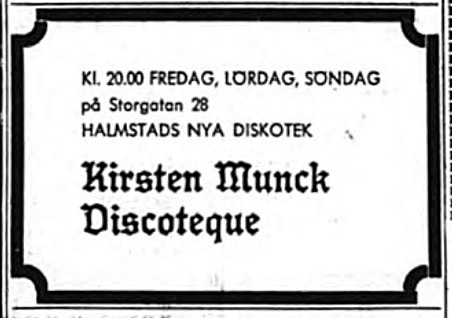
The first discotheques in Halmstad city, according to the advertisement pages of Hallandsposten.
Towards the end of the 1960s, numerous small pop clubs appeared in Halmstad, and they were not always advertised in Hallandsposten, so this list may be missing some clubs. Moreover, the boundary between a pop club and a discotheque was fluid. Included here are the venues that advertised in Hallandsposten as discotheques up to 1970.
A couple of the early venues that did not advertise in Hallandsposten, but occupied the grey area between pop club and discotheque, were Pop Eye, which was located in Söder, and Shake In at Folkparken.

It opened in October 1966 and advertised itself as a discotheque. It was located at Norra vägen 53, in a building that stood north of Örjansskolan, where the northern approach road runs today.

Grand also decided to enter the discotheque scene. In March 1967, they opened Rrracing Club, but it was short-lived – there are only advertisements for it in Hallandsposten during March 1967. However, Grand returned to the scene in October 1967, when the discotheque Don Quijote opened, followed by Chez “L” in early 1968.

This discotheque opened in January 1968 at Storgatan 40. It was preceded by advertisements in December 1967 announcing disco dancing at Stallet, but the name was soon changed to Club Tarantel. During the day, Restaurant Högvakten operated in the premises, but in the evening the furniture was rearranged and the venue became a discotheque instead.

They opened in March 1969 at Mårtenson. The discotheque was located in the upper salon at Adam och Eva, which featured live music on other evenings, but was transformed into a discotheque on Friday nights.
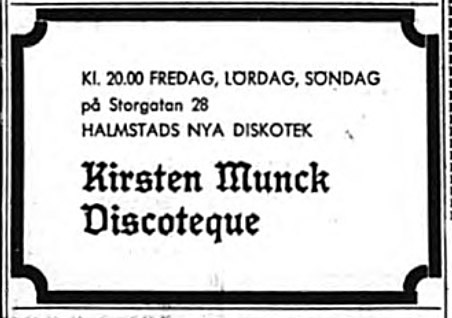
Opened in November 1969 at Storgatan 28.

At Folkparken, disco dancing was held for the first time on New Year’s Day 1970. By then, disco dancing was firmly established in Halmstad, and during the 1970s the number of new discotheques grew rapidly.

 English

 Svenska