The Earliest Period, 900–1200
n Snorri’s royal sagas, written in the 13th century, there is an account of a naval battle at...
At the end of the 13th century, the Danish Crown founded the town of Halmstad by granting trading rights to the area surrounding the royal estate of Halmstad.
n Snorri’s royal sagas, written in the 13th century, there is an account of a naval battle at...
In Heimskringla there is a description of the naval battle between King Sven Estridsen of Denmark and King...
Halmstad’s first written charter was signed in Falkenberg on 31 May 1307.
On 6 December 1270, the learned monk Petrus de Dacia (Peter of Denmark) arrived in Halmstad.
Where do Halmstad's three hearts come from?
In the 1320s, the town of Halmstad was moved from the area now known as Övraby to a...
Halmstad was an important meeting place throughout the period of the Kalmar Union. Many negotiations between the Scandinavian...
The Engelbrekt Rebellion broke out in Småland in 1434. The main causes of the uprising were King Erik...

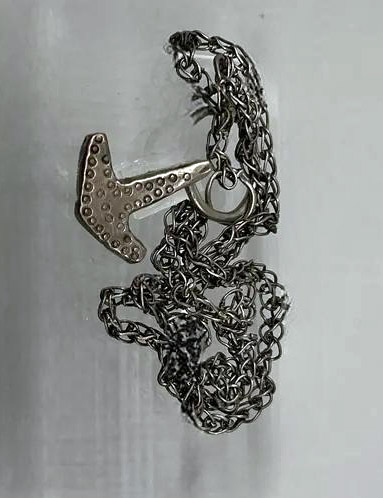
A Thor’s hammer pendant from the Slottsmöllan silver hoard..
Archaeological investigations have uncovered a silver hoard dating from the 10th century near the River Nissan, on the grounds of Slottsmöllan. Excavations around Övraby have also revealed evidence of settlement dating back to the Viking Age. Place names ending in -stad are considered by place-name scholars to be older than the Viking Age.
I Snorres kungasagor och i ytterligare ett par källor från 1200-talen berättas om ett sjöslag vid Nissans mynning år 1062 mellan danska kungen Sven Estridsen och Norges kung Harald Hårdråde.
Snorri’s royal sagas, together with a couple of other 13th-century sources, tell of a naval battle at the mouth of the River Nissan in 1062 between King Sven Estridsen of Denmark and King Harald Hardrada of Norway.
The sources describing the battle were written almost 200 years after the event is said to have taken place. There are no contemporary written sources or archaeological finds that can confirm the accounts given in the royal sagas.
This is how the battle is described in Snorri Sturlason’s Heimskringla.
Some historians believe that a naval battle involving Viking ships may have taken place off Halmstad in 1062, while others are more sceptical. What most historians agree on, however, is that the events said to have taken place around the battle are largely part of the saga tradition found in Heimskringla.
Snorri’s account is written from a distinctly Norwegian perspective. Although Snorri Sturluson lived in Iceland, he had strong ties to Norway.
There could not have been 500 ships off the Halland coast, as the saga claims. Nor is it likely that King Sven Estridsen’s Danish fleet was completely defeated or that he fled ashore at Söndrum.
Sources:
Mattias Öbrink. Vår by Broktorp
Sven A Nilsson. Halmstads historia Del 1
GHÅ 1926. Fredrik Vetterlund. Ett medeltida privatbrev från Halmstad
GHÅ 1933. Harald Nilsson. Sankta Katarina kloster
GHÅ 1961. Harry Hedin. Städerna Halmstad och Broktorp
GHÅ 1995. Lauritz Weibull. Halmstad rådhusarkiv 1307-1645

In the book Heimskringla, which forms part of the Old Norse sagas known as the Edda, there is a passage describing the naval battle between King Sven Estridsen of Denmark and King Harald Hårdråde of Norway.
Snorri Sturluson’s Heimskringla was written down around 1230, more than 200 years after the Battle of the Nissan is said to have taken place. We do not know what sources he used.
The text below is an extract from Emil Olson’s translation of Heimskringla, published between 1919 and 1926.
Translation to English 2026 by Chat GPT.
This is how Snorri describes the battle
The battle-bold prince Harald said
what he believed was now at hand:
for him, all hope of peace
had surely come to an end.
The renowned king proudly urged
his men to fight to the last,
choosing to fall as one
rather than retreat.
In answer, they seized their weapons.
Thus speaks Thjodolv:
The generous lord of men,
kind to the wolves, let the dragon
joyfully ride the waves,
leading the fleet into battle.
The battle-hardened king urged
his brave men to stand firm;
the prince’s companions formed
a wall of shields along the gunwales.
The glorious hero of great deeds
surrounded the dragon at the Nissan
with a ring of red shields,
packed as tightly together
as men standing shoulder to shoulder.
Thus speaks Sten Heridsson:
The king’s marshal urged us,
when the battle began at sea,
never to give way in the fight—
the long spears were trembling.
Undaunted, he ordered
his men to bring their dragon-ship
forward alongside the king’s;
his warriors were quick to obey.
It was no small danger
for the brave lord of the Hersirs
when he faced the Danes,
with a hundred and fifty longships.
The ruler of Leire
ploughed through the waves, eager for battle,
on his way to the fight,
with twice as many gilded ships.
Harald blocked the prince’s way
at the mouth of the river.
The battle was fiercely fought;
the king asked for no peace.
The king’s sword-bearing followers
rowed into battle in Halland;
warm red blood flowed
from their wounds into the sea.
The two valiant chieftains,
scorning the protection of their shields,
eagerly urged on their men—
the ships were now close together.
Stones and arrows flew thick and fast,
and from the sharp blades
dark-red blood dripped.
Many men met their death.
The two valiant chieftains,
scorning the protection of their shields,
eagerly urged on their men—
the ships were now close together.
Stones and arrows flew thick and fast,
and from the sharp blades
dark-red blood dripped.
Many men met their death.
Sven, the fearless king,
did not leave his ship
unless forced to do so, I believe—
the swords rang hard against the helmets.
The splendid ship commanded
by the eloquent favourite of the Jutes
was left empty before the king fled
from his fallen warriors.
The swift lord of the Sygnians,
so the story tells,
destroyed in a single day
seventy of the Danes’ splendid longships.
Sven has no jarls to reward
for the victory—six of them—
although they had fought
with great courage in the battle.
Arne’s son, ever eager for combat,
who refused to save his life by flight,
was captured in the midst of the host.
King Sven’s Escape
Jarl Håkon remained behind with his ship while the king and the other men pursued the fleeing enemy. He was unable to move forward because the ships in front of him were blocking the way. Then a man in a small boat rowed up to the jarl’s ship and came alongside the raised stern. He was a tall man wearing a broad-brimmed hat. He called up to the ship:
“Where is the jarl?”
The jarl was in the forward part of the ship, tending to a wounded man and stopping the flow of blood. He looked at the man in the hat and asked his name.
“Vandråd is here. Speak with me, jarl!” the man replied.
The jarl leaned over the side of the ship towards him. The man in the boat then said:
“I ask you to spare my life, if you are willing to grant it to me.”
The jarl stood up, called for two of his men, both trusted friends, and said to them:
“Get into the boat and take Vandråd ashore. Go with him to my friend, the farmer Karl, and give Karl this token of recognition: he is to give Vandråd the horse I gave him a few days ago, together with his own saddle, and send his son with him as an escort.”
The two men climbed into the boat and took up the oars. Vandråd took the helm.
This happened early in the morning, when there was also the greatest movement of ships. Some were rowing towards the shore, others out to sea, with both large and small vessels moving in all directions. Vandråd steered wherever he could find the clearest passage between the ships. Whenever Norwegian ships came close, the jarl’s men told them who they were, and the Norwegians allowed them to continue on their way. Vandråd steered along the shore and did not land until they had passed the great mass of ships. They then made their way to Karl’s farm. It was beginning to grow light.
They entered the house, where Karl had just finished dressing. The jarl’s men told him why they had come. Karl replied that they should eat first. He had a table set for them and brought them water to wash. Karl’s wife entered the room and said:
“It is strange that we have had neither sleep nor rest tonight because of all the shouting and noise.”
Karl replied:
“Do you not know that the kings have been fighting tonight?”
She asked:
“Who has won?”
“The Norwegians have won,” Karl replied.
“Then our king must have fled again?” she said.
“We do not know whether he has fled or fallen,” Karl answered.
She said:
“We are badly served by our king. He is both lame and cowardly.”
Then Vandråd said:
“The king is not a coward. He is simply not favoured by victory.”
Vandråd was the last to wash his hands. When he was given the towel, he wiped his hands in the middle of it. Karl’s wife grabbed the towel and pulled it away from him, saying:
“You clearly know little about good manners. Only a farm labourer would wet the whole towel at once.”
Vandråd replied:
“I expect I shall find myself somewhere again where I can wipe my hands in the middle of the towel.”
Karl then set the table for them, and Vandråd sat down in the middle. They ate for a while and then went outside.
By then, the horse had been saddled, and Karl’s son was ready to accompany Vandråd. He had another horse of his own.
The two men rode into the forest, while the jarl’s men returned to their boat and rowed back out to the jarl’s ship.
Source:
https://cornelius.tacitus.nu/heimskringla/harald-hardrade/61-70.htm#70
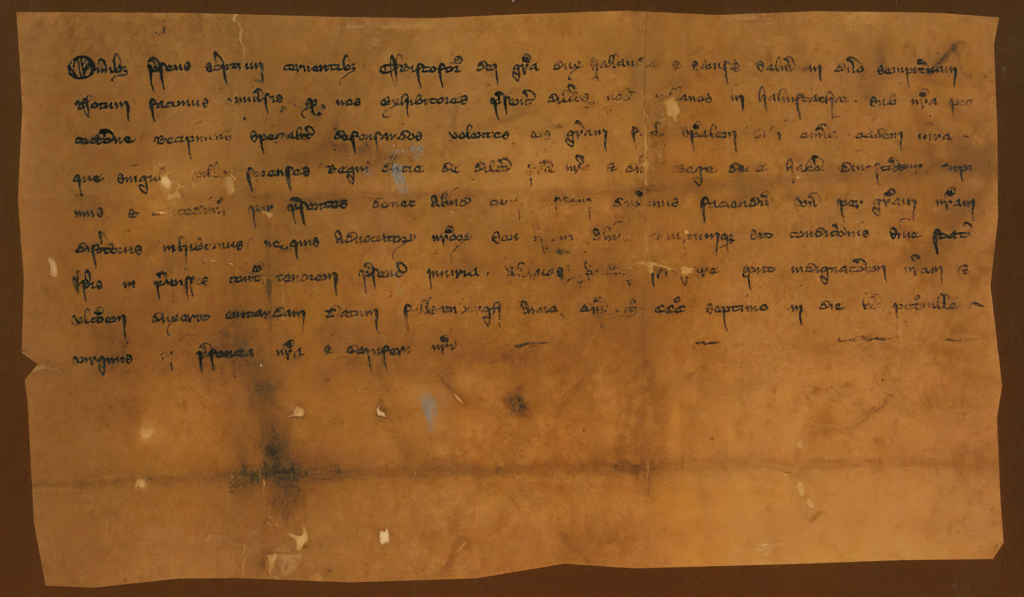
The first written mention of Halmstad dates from 1231, in King Valdemar’s Land Register. This was a record that, among other things, listed the king’s revenues from different districts and trading places.
The register states that the royal estate of Halmstad was located in Halmstad Hundred.

King Valdemar’s Land Register

In 1264, Pope Urban IV wrote a letter to the prior of the Dominican convent in Halmstad. This tells us that the Dominicans had established themselves in Halmstad by that year.
The Dominicans founded their monasteries almost exclusively in towns and cities. Their presence in Halmstad therefore indicates that the town was already an important trading place, with a settlement that had urban characteristics, by 1264.
In the 13th century, towns were rarely granted written charters. Instead, the king would usually grant such privileges orally during a personal visit. King Christopher I of Denmark (1252–1259) visited Halmstad on several occasions and owned a number of estates in the surrounding area. We do not know whether the subject of town privileges was ever discussed during these visits.
At this time, Halmstad was located upstream along the River Nissan, in what is now known as Övraby.
Halmstad’s first written charter from 1307
Halmstad’s first written charter was signed in Falkenberg on 31 May 1307. The burghers of Halmstad travelled to Falkenberg to meet Duke Christopher. He granted them his favour by giving the burghers of Halmstad the same rights that the Danish towns had received from Christopher’s brother, King Erik Menved of Denmark.
Halmstad used this date as the starting point for the city’s 700th-anniversary celebrations in 2007.
Sources:
Mattias Öbrink. Vår by Broktorp
Sven A Nilsson. Halmstads historia Del 1
GHÅ 1926. Fredrik Vetterlund. Ett medeltida privatbrev från Halmstad
GHÅ 1933. Harald Nilsson. Sankta Katarina kloster
GHÅ 1961. Harry Hedin. Städerna Halmstad och Broktorp
GHÅ 1995. Lauritz Weibull. Halmstad rådhusarkiv 1307-1645

The seal of Petrus de Dacia
Petrus de Dacia was on his way back to the Dominican convent in Skänninge, where he was a lecturer in theology. He had spent three years studying in Paris and Cologne.
At the time, Halmstad was one of the last Danish settlements before entering Swedish territory.
In January 1271, Petrus de Dacia wrote a letter to Christina of Stommeln. During his time in Cologne, he had witnessed the young peasant girl’s religious ecstasies and spiritual struggles. Petrus became deeply attached to Christina and, in his letter, addressed her as his “dearest sister Christina.”
He wrote:
“Know, beloved, that although I am in good health physically, I am deeply troubled in spirit because of the many hardships I have endured on my journey.”
Petrus did not mention Halmstad itself in the letter, but he did make a brief comment about the weather:
“You should also know that, although it has not been as cold for many years in Dacia as it has been this year, I have not worn a fur coat.”
Petrus and Christina continued to exchange letters throughout their lives, and they also met a few times during Petrus’s travels. Petrus died in Visby in 1289.
This is the oldest surviving private letter known to have been sent from Halmstad. It is preserved in the Vatican Archives. At the time, letters were carried by travellers who stayed at monasteries along their routes, and it could take a long time for a letter to reach its recipient.
Sources:
Mattias Öbrink. Vår by Broktorp
Sven A Nilsson. Halmstads historia Del 1
GHÅ 1926. Fredrik Vetterlund. Ett medeltida privatbrev från Halmstad
GHÅ 1933. Harald Nilsson. Sankta Katarina kloster
GHÅ 1961. Harry Hedin. Städerna Halmstad och Broktorp
GHÅ 1995. Lauritz Weibull. Halmstad rådhusarkiv 1307-1645


The Origin of the Three Hearts
As early as 1603, Halmstad was known to have a coat of arms featuring three crowned hearts.
There is a popular story about how Halmstad came to have these three hearts. According to the story, King Christian IV of Denmark used a heart as his personal symbol, and a crowned heart was said to appear on his seal. It was therefore believed that Christian IV gave Halmstad the three hearts as the city’s symbol.
However, this story is not correct. No known seal of Christian IV features a heart. It is true that he used a heart in connection with his motto, but the earliest known evidence of this dates from 1629—25 years after Halmstad received its coat of arms.
So where did Halmstad’s three hearts really come from?
To find the answer, we have to go back several hundred years, to the time of King Valdemar Sejr, who ruled Denmark from 1202 to 1241. Valdemar had a grandson named Erik Knutsson, who became Duke of the four southern districts, or hundreds, of Halland. Another of Valdemar’s sons, Niels, became Count of Halland. His grandson, Jakob Nilsson, was given the four northern hundreds of Halland as his county in 1283.
These descendants of Valdemar all used hearts in their coats of arms.
By around 1450, hearts had also appeared in the Danish royal coat of arms. Historians believe that these hearts represented the coats of arms of the dukes and counts of Halland. This gives us a much more likely explanation for Halmstad’s three hearts.
When Christian IV granted Halmstad its coat of arms in 1603, the heart had already been used as a heraldic symbol in Halland for some 300 years. For about 150 years, hearts had also represented Halland in the Danish royal coat of arms. For Christian IV, it would therefore have been quite natural to give Halmstad—the principal city and administrative centre of Halland—a symbol that was already so closely associated with the province.
The three hearts of Halmstad were not a new invention. They were part of a much older Halland tradition, reaching back to the medieval rulers of the region.

In the lower right-hand section of the coat of arms, there are seven hearts. They are positioned between a walking lion above and a dragon below.
A Danish royal seal dating from around 1450 shows nine hearts in the same part of the coat of arms, likewise placed between the lion and the dragon.

In the 1819 version of Denmark’s royal coat of arms, two of the heraldic fields contain walking lions surrounded by a number of small hearts.
Halmstad’s coat of arms was officially confirmed by the King in Council on 8 May 1936. The heraldic description is as follows:
Shield: Azure, a fess Argent charged with three crowned hearts Or, each crown open.
Mantling: Argent on the inside and Azure on the outside.
Wreath: Argent and Azure.
Crest: Three sheaves of grain Or, placed side by side.
Earlier Medieval Seals

The earliest known seal of the city of Halmstad dates from the beginning of the 14th century. The original seal matrix was discovered in a marsh near Knäred in 1875.
Knäred was situated close to the border between Sweden and Denmark, and meetings between the two countries were often held there. It is possible that the seal matrix was lost during one of these meetings.
The seal depicts a tournament helmet decorated with four plumes or ears of grain, arranged to form the letter W. Around the image is the inscription S. Civitatis Halmstadensis.
The S is an abbreviation of Secretum or Sigillum, meaning “seal”. The inscription can therefore be translated as “The Seal of the City of Halmstad.”
This medieval seal is the symbol of the Old Halmstad Society (Föreningen Gamla Halmstad) and is shown in the heading of this website. The seal remained in use until 1584.

Other seals featuring the same design as the medieval seal described above have also existed. The historian Sven Peter Bexell mentions two seals that were in use in the early 19th century and carried the same design as the earlier seal.
These seals have since been lost. The image shown here is based on a seal matrix made in 1922, recreating the design of the earlier seals.

The next known seal dates from 1603. It shows a shield bearing three crowned hearts, surmounted by a helmet and three sheaves of grain, which had been retained from the city’s earlier coat of arms.
The seal bears the inscription Civitatis anno 1603 Helmstadiensis, meaning “The City of Halmstad, in the year 1603.”
This seal was granted to the city by King Christian IV of Denmark and forms the basis of Halmstad’s present-day coat of arms.

At the beginning of the 19th century, a new seal was made. It contained the same symbols as the 1603 seal: a shield with three crowned hearts, surmounted by a helmet and sheaves of grain.
The inscription around the seal was changed to Sigillum Civitatis Halmstadiensis, meaning “The Seal of the City of Halmstad.”
Sources:
Danström Ludvig, Halmstads sigill, GHÅ 1924
Dunér Uno, Halmstads vapens ursprung. GHÅ 1995
Peterson Stig-Åke, Kommunvapen i Halland, Halland 1978
Roth Nils, Halmstad, svenska stadsmonografier 1946

The Broktorp estate was located at the mouth of the River Nissan, on a sandbank west of the river. Traces of settlement dating from the Late Iron Age have been found in the area.
During the Viking Age, between the 8th and 11th centuries, a farm was established near what is now the intersection of Storgatan and Brogatan. Archaeological investigations indicate that the area had become densely settled before the town was moved. The amount and type of refuse found there resemble those normally associated with an urban settlement.
In the 1320s, the town of Halmstad was moved from the area we now call Övraby to the area around the Broktorp estate. For several years, the two settlements existed side by side.
Broktorp is referred to as a town as early as 1322, but when the town received a new charter in 1327, its name had been changed to Halmstad.
The relocation of the town was not a single event but a gradual process that took several years to complete.
It was probably the Danish Crown that decided to move the town, most likely because its location at the mouth of the River Nissan offered better opportunities for trade and shipping.
Among the archaeological finds from the 14th century, there is an unusually large amount of North German pottery. This suggests that German merchants were a common sight in Halmstad as well. At the time, the Hanseatic League dominated trade around the Baltic Sea, and the archaeological finds suggest that many German merchants may have been living in Halmstad.
In 1350, the Black Death reached Scandinavia, and Halmstad was almost certainly affected, although this is not documented in any surviving sources. Nor have archaeologists found any clear traces of the plague in the excavations carried out in the town.
It is estimated that between 30 and 50 percent of the population of Denmark and Sweden died during the Black Death.
Sources:
Mattias Öbrink. Vår by Broktorp
Sven A Nilsson. Halmstads historia Del 1
GHÅ 1926. Fredrik Vetterlund. Ett medeltida privatbrev från Halmstad
GHÅ 1933. Harald Nilsson. Sankta Katarina kloster
GHÅ 1961. Harry Hedin. Städerna Halmstad och Broktorp
GHÅ 1995. Lauritz Weibull. Halmstad rådhusarkiv 1307-1645
GHÅ 2014. Mattias Öbrink. Brogatans historia

The Kalmar Union was established at a meeting in Kalmar in 1397, where Erik of Pomerania was crowned king of Sweden, Denmark and Norway
There was widespread dissatisfaction with Erik of Pomerania, and five years later Christopher of Bavaria was elected as the new king of the Kalmar Union. By 1450, Christopher had died, and a Nordic meeting was held in Halmstad to discuss the future of the Union.

Erik of Pomerania
This is how St. Nicholas Church may have looked in the 15th century.
Image created by Peter Lundqvist
The period of the Kalmar Union was turbulent, with frequent conflicts between Denmark and Sweden. Nevertheless, the Union survived, despite several interruptions during which the individual kingdoms chose their own kings.
Many negotiations during this period were held in Halmstad, which remained an important meeting place throughout the entire period of the Kalmar Union. The earliest meetings took place at the Dominican friary, and later also in the newly built St. Nicholas Church.
In February 1520, a Danish army of around 1,500 men, many of them mercenaries, assembled in Halmstad. The army joined forces with troops from Gothenburg, and together they marched towards Stockholm.
At the Battle of Åsunden, the Swedish forces were defeated on the frozen lake. Sweden’s regent, Sten Sture the Younger, died from his wounds.
The Danes, led by King Christian II, then captured Stockholm. Christian was subsequently crowned King of Sweden. During the celebrations that followed his coronation, the Stockholm Bloodbath took place.
Important Dates for Halmstad During the Kalmar Union
1434 and 1436 – The Engelbrekt Rebellion; Engelbrekt stayed in Halmstad.
1435 – A meeting in Halmstad between King Erik of Pomerania and representatives of Sweden.
1441 – A meeting in Halmstad between King Christopher, Karl Knutsson Bonde and Axel Pedersen Thott.
1450 – A Nordic meeting was held in Halmstad.
1468 – A peace meeting was held in Halmstad.
1483 – Negotiations concerning the election of a common king were held in Halmstad.
Sources:
Sven A Nilsson. Halmstads historia Del 1
GHÅ 1997. Knut Nilsson. Halmstad under Kalmarunionen
GHÅ 1998. Peter Lundqvist. S:t Nikolai kyrka. Från unionstid till reformationen

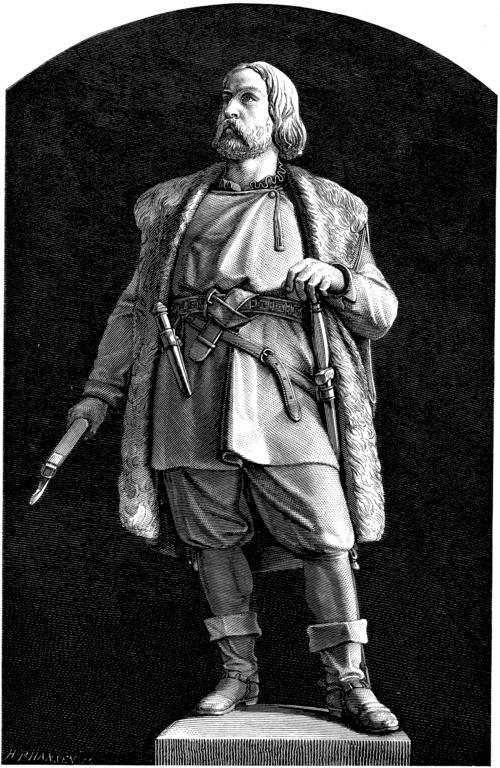
Engelbrekt Engelbreksson
In 1434, the Engelbrekt Rebellion broke out in response to King Erik of Pomerania’s increased taxes and the introduction of customs duties in the Øresund. The uprising quickly spread across large parts of Sweden.
Several of the royal castles where the king’s bailiffs were based were captured or destroyed. Peasants, regional assemblies and powerful noblemen joined Engelbrekt Engelbrektsson and supported his rebellion.
When Engelbrekt and his troops reached Halmstad, the townspeople opened the city gates and allowed him to enter. This happened both in 1434 and during the second wave of the rebellion in 1436..
The medieval chronicle Karlskrönikan describes Engelbrekt’s arrival in Halmstad:
The townspeople feared that harm would come
when Engelbrekt approached the town.
They did as he asked them to do:
they opened the gates and let him ride inside.
Sources:
Sven A Nilsson. Halmstads historia Del 1

 English
 Svenska