The Arrival of the Railway
Halmstad’s first railway opened in July 1875 and ran to Torup.
In the final years of the 19th century, railways and motor traffic arrived in Halmstad. In the early 20th century, electricity and running water were introduced. A few years later, the first homes were connected to electricity.
Halmstad’s first railway opened in July 1875 and ran to Torup.
The first automobiles appeared in Halland in 1902. They were vehicles from outside the region passing through.
In the late 1870s, merchant Gustav Adolf Segerlind established a telephone connection between his general store at Stora...
It was the industries that introduced electricity to Halmstad. The jute mill in Oskarström had electricity from the...
In earlier times, the well at what is now Källegatan was the source of drinking water where the...

In the 1860s, land transport was served by the postal stagecoach, while steamships provided transportation by sea. From the forest districts of Halland and Småland, staple goods were transported by ox-drawn carts or horse and cart for shipment from the harbour at the mouth of the River Nissan.
In August 1869, Halmstad’s municipal council invited the citizens to the Town Hall to present its plans for a railway. A subscription list was circulated to raise funds for a feasibility study, and 1,200 riksdaler was collected.
On 31 March 1870, around one hundred people from Halmstad, Halland and Småland gathered at Hotel Mårtenson and founded the Halmstad–Jönköping Railway Company, which was later renamed the Halmstad–Nässjö Railway.
Express train No. 1 at Torup Station in 1885
The first section of the railway ran to Torup. In July 1875, limited private freight services to Torup began. This marked the beginning of operations on Halmstad’s first railway.
A simple station building was constructed in Öster, where Halmstad Central Station stands today. At the time it was built, the area was surrounded by grazing land, grain fields and farmland, with marshland in some places. The road connection between the town and the railway station was, to put it mildly, very poor. In the following years, Östra Förstaden began to be developed, and the roads were improved.
For Halmstad, the arrival of the railway led to increased shipping traffic and a need for a larger harbour. The municipal council therefore decided to build a 180-metre-long stone quay on the eastern side of the River Nissan. The West Coast Railway and the Bolmen Railway further increased harbour traffic, and new quays had to be built.

Maintenance crew at HNJ, 1896.
1877 — The railway between Halmstad and Värnamo was completed.
1882 — The railway between Halmstad and Nässjö was completed.
1888 — The West Coast Railway between Gothenburg and Helsingborg was completed.
1889 — The railway between Halmstad and Bolmen was completed.
Sources:
Sven A Nilsson. Halmstad historia Del 3 – Järnvägar och industriområden
Sven Aremar. Staden – Havet – Människorna – Järnvägsbygge och järnvägsfolk
Sven Aremar. Kors och tvärs i tid och rum – En hotellgata på öster
GHÅ 2012: KB Bjering. Halmstad-Nässjö järnväg fram till 1985.
GHÅ 1937: Arvid Kindberg. Halmstad-Bolmens Järnvägs historia till 1923.

The first automobiles appeared in Halland in 1902. They were vehicles from outside the region passing through. The newspaper Halland described them as “huge continental automobiles, as large as threshing machines.”
In 1904, an automobile from Gothenburg drove down Högelid and into Halmstad. Hallandsposten described how several horses bolted in fright at “the panting monster.”
In 1907, automobiles in Sweden began to be registered by the Stockholm Police Board. All cars were assigned an identification mark that same year. At the same time, a certificate of competence was introduced as a requirement for driving a car.

Some of the first cars in Halmstad had probably been in the town for several years before they were registered in 1907.

1903 Oldsmobile
No. 2 — The owner was Axel Peter Nilsson, who had founded the Rex bicycle factory a few years earlier. The photograph shows Axel Peter Nilsson’s son in a 1903 Oldsmobile.

Painting by Nils Johansson
Nos. 9 and 10 — Wallberg Factory Company
These were the lorries owned by factory owner Isak Wallberg, which were used to transport grain and flour from Slottsmöllan to the town.
The lorries travelled at 20 km/h, weighed 10 tonnes, and had iron wheels. They caused considerable damage to the roads, and houses shook as the lorries drove through the town.

1905 Cadillac
Photo: Nordiska museet
The first taxi service in Halmstad was established by Anders Grahm, who in 1908 ordered three Cadillac automobiles equipped with taximeters to add to his horse-drawn carriage business.
The automobiles were stationed at Stora Torg. Opinions about the new cars were divided:
– Elegant, easy to handle, and quiet.
– The cars are like a herd of mastodons that has taken possession of the town, chasing prey up and down the streets.
No. 4 — The owner was pharmacist Oscar Emil Wallén, who built a house with a pharmacy at 12 Köpmansgatan when he came to Halmstad in 1905.
No. 11 — Oskar Reinhold Wallberg, son of factory owner Isak Reinhold Wallberg of Slottsmöllan.

1925 Chevrolet
Photo: Västergötlands Museum
In the 1920s, the Levin family, who sold bicycles, expanded their business to include car sales.
The brands they sold were Dodge, Chevrolet, and Ford.
The Chevrolet cars arrived in huge wooden crates in separate parts, which were then assembled at the Levin family’s premises.
Traffic Through Halmstad
All through traffic passed through Norre Port along Storgatan and over Österbro.
Traffic increased rapidly, and in 1927 a traffic police officer was stationed at the intersection of Storgatan and Brogatan.
Police Constable Viktor Finnberg directed traffic at the intersection until 1939.
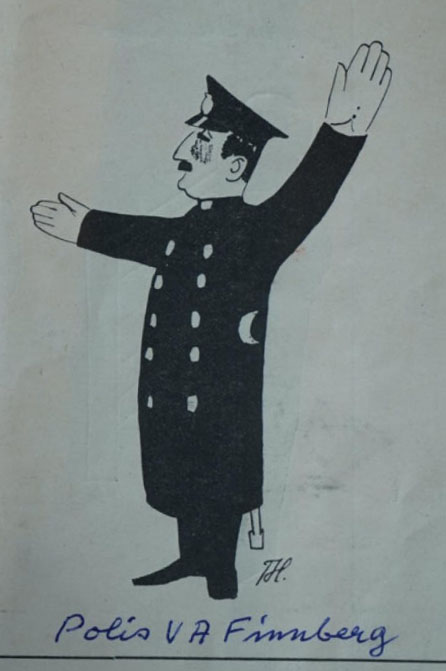
Drawing from the caricature booklet Halmstadlaxar, 1935

Traffic through Norre Port in the 1930s
In 1929, Halmstad’s first traffic lights were installed to regulate traffic through Norre Port.
In 1939, traffic through Norre Port was made one-way. Southbound traffic passed through the gate, while northbound traffic was routed via Skolgatan and Fredriksvallsgatan.
In 1971, motor traffic through Norre Port was prohibited altogether.
In 1956, Slottsbron was completed, and through traffic was diverted from Storgatan and Österbro.
Instead, traffic travelled from Högelid via Karl XI väg to Slottsbron.
In 1967, the E6 motorway east of Halmstad was opened, bringing an end to through traffic in central Halmstad.

Sources:
Stockholms polisstyrelse, Meddelanden angående automobiltrafik 1907
Sven Aremar. Kors och tvärs i tid och rum. – När automobilen kom till stan
Erik Hägge. Norre Port rediviva
GHÅ 1927: Axel Westman. Apotek och apotekare
GHÅ 1965: Å. R. En pioniär på två hjulingar. Axel Peter Nilsson 1860-1948.
GHÅ 1988: Thorsten Rehn. Kungen bland cyklar.

The Telegraph Office
Halmstadbladet, 12 October 1854
“On 12 October 1854, most of the officials living in the town, together with many of its merchants and others, had arranged a festive evening dinner for Major Fahnehielm, who had by then completed the establishment of the telegraph office in the town and opened the telegraph service from Halmstad.”
Telegraph apparatus from 1870
Photo: Swedish National Museum of Science and Technology
In February 1854, construction of a telegraph line through Halland had begun, but the work was delayed because the procurement of telegraph poles proved more expensive than expected. By October, however, the line was complete and a telegraph station was opened in the Eriksro building, located where the 035 building stands today.
The following year, the telegraph station was moved to Östra Vallgatan (present-day Hamngatan).
Having a telegraph station in Halmstad meant that newspapers could report events outside the immediate area considerably faster than before.
Telephony
In 1878, three years after the year in which Bell is generally considered to have invented the telephone, the Swedish Telegraph Administration’s view of this new means of communication was that the telephone “could by no means be extended over distances as great as those covered by telegram transmission.”
The administration was even doubtful as to whether the telephone could be of any use between nearby towns.
As early as the late 1870s, merchant Gustav Adolf Segerlind established a telephone connection between his general store at Stora Torg and his home on Fredriksvallsgatan. This is considered to have been Halmstad’s first telephone connection.
Halmstad Telephone Association

An old Telephone Exchange
On 14 August 1882, Halmstad residents interested in the new technology gathered at Hotel Mårtenson and formed a telephone association with 30 members. The telephone exchange was installed at the Freemasons’ Lodge, where telegraph attendant Thyberg and his wife operated the exchange from 7 a.m. to 8 p.m.
Interest was considerable, but the number of subscribers was limited by the capacity of the exchange at the Freemasons’ Lodge. For example, the police telephone at the Town Hall could not be connected. To contact the police station, people instead had to call Hotel Svea, which would send one of its waitresses over to the police station.
In 1892, a telephone line was established between Gothenburg and Halmstad. Through a long-distance telephone service at the telegraph station, it was now possible to make long-distance calls.
Following negotiations with the Swedish Telegraph Administration, the telephone association’s operations were transferred to the Telegraph Administration, and all subscribers were connected to the national telephone network in the autumn of 1892.
Source:
GHÅ 1991: Erik Hägge. Halmstads första telekommunikationer

It was the industries that introduced electricity to Halmstad. The jute mill in Oskarström had electricity from the time it opened in 1886. Halmstad Foundry had electricity before 1888, and Slottsmöllan was supplied with electricity in 1890.
Halmstad’s first electric lighting was introduced in 1888, when Halmstad Foundry laid a cable from the eastern side of the River Nissan to Norre Katts Park and illuminated parts of the park.
The image shows one of the Power Utility’s steam boilers in 1923.
Photo: Selma Angel
This changed the minds of the majority of the members of the municipal council, who had previously been opposed to the idea, and they decided to build an electricity station. It was located at 39 Hamngatan, and operations began there on 22 September 1890. Electricity was generated by steam-powered generators, and the building had a 38-metre-high chimney.
The town model shows four arc lamps on Stora Torg, but a total of 48 arc lamps were installed throughout the town centre. Interest in installing electricity in private homes also began to grow, increasing year by year.
Sources:
Sven Aremar. Ur källor och arkiv, Hamngatan – stadens baksida
Sven Olof Olsson. Från säck till väv. Halmstad industrihistoria VI,

Water
In earlier times, the well at what is now Källegatan was the main source of drinking water for the people of Halmstad. During the 19th century, more and more private wells were dug on properties throughout the town, while wastewater was poured directly into the streets. This resulted in falling groundwater levels and contaminated wells.

The water source was located at the intersection of Källegatan and Fredriksvallsgatan.
Photo from the town model
From the beginning of the 19th century to the early 1880s, the population of Halmstad had increased almost tenfold. This made the need for a centrally organised water supply increasingly urgent.
To avoid having to transport water by horse and cart, a water pipeline was built in 1870 from the water source at Västerkatt to the Appeltoft Brewery in Tre Hjärtan House. The pipeline was also used by the fire brigade and a few other subscribers.
In 1883, Halmstad’s municipal council decided “that a water supply system should be constructed in the town.” At that time, only around ten Swedish towns had previously decided to build a municipal water supply system. However, privately constructed water pipelines of a simple design had existed in Halmstad much earlier.
It was decided to build a pipeline from Lake Toftasjön, which lies 80 metres above sea level. A sand filtration bed was constructed on Galgberget, together with a reservoir built next to the observation tower. This made it possible to begin installing pressurised water pipes in the town’s properties.
Sewage
In earlier times, wastewater was poured directly into the street outside each property. When running water was introduced into buildings towards the end of the 19th century, followed by flush toilets, it became necessary to install underground pipes to carry away the wastewater. These sewer pipes discharged directly into the River Nissan.
It was not until 1962 that Halmstad’s wastewater was connected to a treatment plant, which was completed that year in Söder. Until then, the town’s wastewater had been discharged untreated into the River Nissan. In the 1960s, around 30 sewer pipes from Halmstad discharged into the River Nissan.
Sources:
GHÅ 1984: Agne Edwin. Från ok till elektronik
GHÅ 2001: Kenneth Wiland. Frans August Wiland, Halmstads förste “vattenledningsentreprenör”
GHÅ 2007: Lennart Lorick. Vatten för 1 öre litern
GHÅ 2012: Anders Bergenek. Året är 1962

 English
 Svenska