The Free Church Movement
Initially, free churches generally had to hold their meetings in the homes of their members. As their activities...
Initially, free churches generally had to hold their meetings in the homes of their members. As their activities...
The temperance movement came to Halmstad in 1882 – and it made quite an impact. No fewer than...
Towards the end of the 19th century, both branches of the labour movement took root in Halmstad. The...
In 1967, the Vietnam War was raging, while opposition to the war and protests against it were growing....


The Baptists Painting by Gustaf Cederström
The revival movement was perhaps the first religious movement in Sweden to emerge from the Pietist tradition that had developed during the 18th century. However, the first truly independent free church, completely separate from the established Church of Sweden, was the Baptist Church, which arrived in Sweden in 1848.
In Halmstad, the Church of Jesus Christ of Latter-day Saints, commonly known as the Mormon Church, was probably the first to establish a presence, around 1850. This was followed by numerous new congregations and denominations during the following decades.
Like the other major popular movements, the free churches initially generally held their meetings in the homes of their members. As their activities grew, however, the need for premises of their own became increasingly apparent. With one exception, all of these churches were located outside the old moat.

Immanuel Church
The first congregation to acquire its own premises was the Mission Congregation. This happened around 1870, when a donation made it possible for the congregation to “purchase a garden, in which a dance hall was soon transformed into a prayer hall.”
Just a few years later, the building was abandoned when a new church was built on Källegatan, with room for 400 people. By the end of the century, this church was also considered too small, and the present Immanuel Church was built to designs by Fritz Eckert of Stockholm.
The Methodist Congregation opened its first church in Halmstad in 1900, on Falkenbergsgatan. It soon proved too small and was also considered too far out on the edge of town.
The building was first sold to IOGT-NTO. It was then used at various times for religious and secular purposes until the Catholic Church purchased it in 1980.
A new Methodist church was built on Skolgatan. Designed by Knut Beckeman of Halmstad, it was inaugurated in 1905. In 1989, the church was sold to the Swedish Evangelical Mission (EFS). It later passed into private ownership and was converted into offices.


In 1905, the Baptist Congregation purchased a property on Torsgatan and converted it into a place of worship called Elim Chapel. The congregation remained there until 1932, when it moved to a newly built church on Karl XI’s väg, designed by city architect Wetterqvist.
The church was sold in the 1990s, and the congregation left the premises in 2002. Today, the building houses a nightclub.
Sources:
GHÅ 1947: Alex Andersson mfl. De frireligiösa rörelserna i Halmstad.
Hallandsposten flera artiklar 1855, 1858, 1910 och 1912

Alcohol-related problems – or perhaps more accurately, the harmful effects of drinking – had been debated for a long time, with the debate becoming increasingly intense from the 1830s onwards. Temperance societies were established in many parts of Sweden. Many of them advocated moderation, in contrast to the Anglo-American-inspired organisations such as the IOGT and NTO, which promoted total abstinence.

The Swedish temperance movement perhaps took on its modern form when the Independent Order of Good Templars gained a foothold in Sweden in 1879. The order reached Halmstad in 1882 – and it made quite an impact. No fewer than three lodges were established in the city that year.
Although, as in other fraternal organisations, some activities within the order were not open to the public, this did not mean that the organisations themselves were secret.
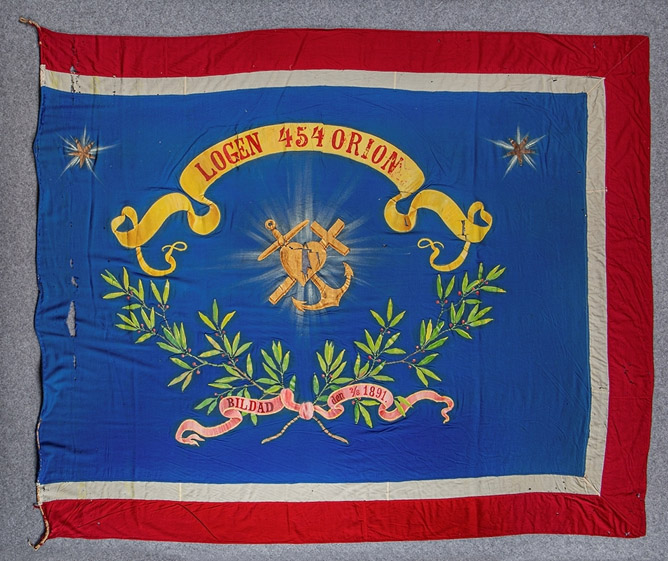
On the contrary, one of the aims was to recruit new members, and that meant being visible. One way of doing this was to proudly display impressive banners, often sewn by members themselves.
Shown here is a banner made in 1916 by master painter Edward Högardh for Lodge No. 353 Wallberg of the NGTO. Some alterations were made when the banner was taken over by Lodge Orion.
Sources:
GHÅ 2024: Stefan Gustafsson. NTO-gården – Berättelsen om en mötesplats på Kärleken.
GHÅ 1954: Werner Johanson. Vi samlas här till ädel strid.
Arkiv Halland

Towards the end of the 19th century, both branches of the labour movement took root in Halmstad. The trade union movement came first, with painters and textile workers organising themselves during the 1880s.
May Day demonstration, 1 May 1979.
Photo: Hallandsposten
There are different accounts of when the first modern trade union was formed in Halmstad. Some sources state that it was among painters and textile workers in 1887, while another source gives 1894 as the starting point, when a local branch was established of what later became the Swedish Metalworkers’ Union.
The political branch of the labour movement was established in 1896. Both branches initially focused primarily on improving the political, economic and social conditions of their members.
At the same time, they made considerable efforts to promote their members’ cultural interests. Music groups, choirs and workers’ libraries were among the activities supported.
From there, it was only a short step to organising purely social and recreational events. The poster below announces one such occasion, held in the spring of 1901.

Sources:
GHÅ 1971: Valfrid Göranson. Socialismens entré i Halmstad.
Svenska Målareförbundets Avdelning 12 arkiv
Svenska Textilarbetarförbundets Avdelning 52 arkiv

In 1967, the Vietnam War was raging at full force. At the same time, opposition to the war and protests against it were growing, particularly in Sweden. In Halmstad, the city’s Vietnam Committee was formed at Café Tre Hjärtan in the spring of 1967.
There may have been movements in Halmstad that could be described as alternative or solidarity movements before this. However, it seems reasonable to see the formation of the Vietnam Committee as the starting point for this type of movement in the city.
Many committees, groups and organisations were formed. People marched for peace and became involved in promoting democracy in El Salvador, Nicaragua and Chile. Campaigns were organised against apartheid in South Africa. Solidarity with the Indigenous peoples of the United States led to the formation of a local group of the Swedish-Indian Association.
A group of people, most of them doctors, formed the Fredagsgruppen (“Friday Group”). They agreed to donate a portion of their income to small-scale aid projects.
The local Amnesty group began campaigning for political prisoners in 1969.
Major global issues remained on the agenda throughout. But national issues also found their place, including the campaign against nuclear power, as well as concerns about nature conservation and the environment.

Byring and Bråte on Söndrumsvägen, 1976.
Photo: Anders Hernborg
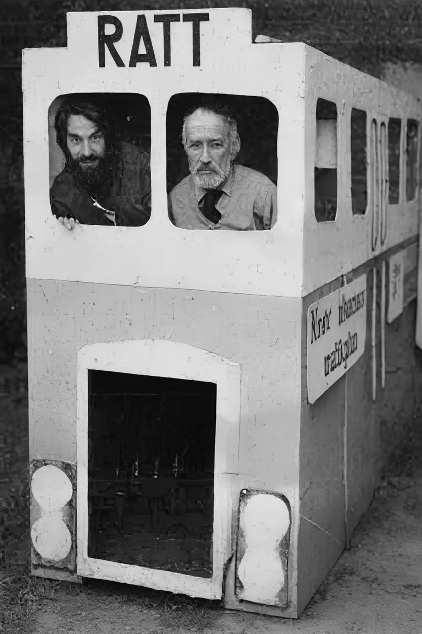
Kenneth Bengtsson and Ingvar Bergman
Photo: Hallandsposten, 23 March 1979
Local issues also inspired activism. Halmstad underwent major redevelopment during the 1960s and 1970s. A recurring solution to the city’s problems was large-scale demolition to make way for new roads and traffic routes.
Opposition to these plans, particularly the so-called Harbour Link, led to the formation of RATT (Rörelsen för Alternativ Tätorts-Trafik, or “Movement for Alternative Urban Traffic”). This was followed by the formation of a new political party that stood for election to the municipal council in 1979. Its name was Alternativ Ett, and its election platform was short and to the point: “No to the ring road.”
Sources:
GHÅ 2014: Bengt Högstedt, Nils Eriksson, LennartAndreasson, Anders Hernborg. Byring & Bråte – 40 år för mänskliga rättigheter.
GHÅ 2015: Nils E Eriksson. Minnen från revolutionsåret 1968 i Halmstad.
GHÅ 2016: Nils E Eriksson. Några av 1970-talets alternativrörelser.
GHÅ 2018: Peter Björk. Från Skolgatan till Saltsjövägen.

 English

 Svenska